Describe and apply techniques for:
a)  Position Fixing;
b)  Changing heading to make good the desired track;
c)  Changing heading to make good next turning point or destination;
d)  Amending ETA.
Archives: Theory Courses
With this information, we can derive a time we will arrive at the destination. This can be given as a time in UTC to a controller or other traffic, or as minutes past the hour (if within 45 or so minutes)
6.28.18 Conversions
Convert between:
a)  Degrees Fahrenheit and Celsius (2%);
b)  Nautical Miles, Statute Miles and Kilometres (2%);
c)  Metres and Feet (2%);
d)  Pounds and Kilograms (2%);
e)  Litres, Imperial and US gallons (2%);
f)  Volume of Fuel (in Litres, Imperial or US gallons) and a Mass of Fuel (in Pounds      or Kilograms) (2%).
Fahrenheit ↔ Celsius
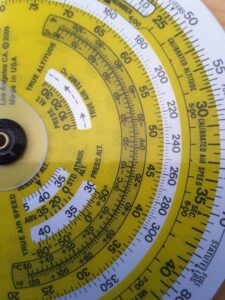
To convert between Fahrenheit and Celsius, we align the Fahrenheit and celsius markers on the inner and outer scales. We read off the temperature on one scale which is converted to the other unit using the scale.
Nautical miles ↔ Statute miles
To convert between Nautical Miles and Statute Miles, we align the Nautical miles and Statute miles markers on the inner and outer scales.
With the scales aligned, we can read off one scale and convert it to the other scale by reading off the number on the opposite scale.
Nautical miles ↔ Kilometers
To convert between Nautical Miles and Kilometers, we align the Nautical miles and KM markers on the inner and outer scales.
With the scales aligned, we can read off one scale and convert it to the other scale by reading off the number on the opposite scale.
Statute miles ↔ Kilometers
To convert between Statute Miles and Kilometers, we align the Statute miles and KM markers on the inner and outer scales.
With the scales aligned, we can read off one scale and convert it to the other scale by reading off the number on the opposite scale.
Metres ↔ Feet
To convert between Metres and Feet, we align the Metre and Feet markers on the inner and outer scales.
With the scales aligned, we can read off one scale and convert it to the other scale by reading off the number on the opposite scale.
Pounds ↔ Kilograms
To convert between Kilograms and Pounds we align the KG and LBS markers on the inner and outer scales. With the scales aligned, we can read off one scale and convert it to the other scale by reading off the number on the opposite scale.
Litres ↔ Imperial Gallons
To convert between Litres and Imperial Gallons, we align the L and Imp Gal markers on the inner and outer scales.
With the scales aligned, we can read off one scale and convert it to the other scale by reading off the number on the opposite scale.
Litres ↔ US Gallons
To convert between Litres and US Gallons, we align the L and US Gal markers on the inner and outer scales.
With the scales aligned, we can read off one scale and convert it to the other scale by reading off the number on the opposite scale.
US Gallons ↔ Imperial Gallons
To convert between US gallons and Imperial gallons, we align the US Gal and Imp Gal markers on the inner and outer scales.
With the scales aligned, we can read off one scale and convert it to the other scale by reading off the number on the opposite scale.
Fuel lbs ↔ US Gallons
To convert between Fuel lbs and US gallons, we align the Fuel LBS and US Gal markers on the inner and outer scales.
With the scales aligned, we can read off one scale and convert it to the other scale by reading off the number on the opposite scale.
Fuel lbs ↔ Imperial Gallons
To convert between Fuel lbs and Imperial Gallons, we align the fuel LBS and Imp Gal markers on the inner and outer scales.
With the scales aligned, we can read off one scale and convert it to the other scale by reading off the number on the opposite scale.
Fuel lbs ↔ Litres
To convert between Fuel lbs and Litres, we align the fuel LBS and L markers on the inner and outer scales.
With the scales aligned, we can read off one scale and convert it to the other scale by reading off the number on the opposite scale.
6.14.2(o) Define Closing Angle (CA);
6.14.2(o) Closing angle (CA);
Closing Angle is a heading correction change, that will regain the aircraft on a track to regain the FPT (flight planned track) to the destination
If you do find yourself off track, a change of heading equal to the track error (TE) will parallel the FPT, and a further change of heading equal to the closing angle (CA) will bring the aircraft back to the FPT within a required distance.
The sum of these two corrections is called the total correction.
TE + CA = Total correction TC
6.48.10 Calculate an aircraft’s position given bearing and distance from an identified ground position.
Calculate an aircraft's position given bearing and distance from an identified ground position.
To calculate an aircraft’s position using bearings and distances from ground positions, involves obtaining bearings from the ground position, and a distance from that feature which will give a reasonably accurate fix.

6.48.8 Calculate a Heading to make good a Reciprocal Track.
Calculate a heading to make good a reciprocal track.
To calculate a Reciprocal Track;
If you have applied left (port) drift before turning around, fly the reciprocal heading and deduct twice the drift.
If you have applied right (starboard) drift before turning around, fly the reciprocal heading and add twice the drift.
6.4.6(k) Define an isogonal;
6.4.6(k) Isogonal;
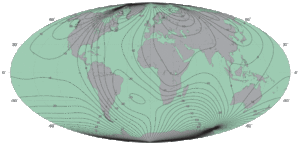
Isogonal lines on a map are lines connecting all points of equal magnetic Variation
6.28.16 Compute Fuel Endurance, given the fuel quantity and burn rate.
Compute Fuel Endurance, given the Fuel Quantity and Burn Rate.
Explain: Fuel Endurance
|
In this Example …. You have 75 litres of fuel on board your Cessna. You check the aircraft Flight Manual and work out that at your planned altitude and power setting, you will burn 23 litres per hour. Looking at the cruise, what is your Fuel Endurance? |
|
|---|---|
| Setup | |
|
1. Find the 23 Litres on the outside
|
|
| Read off | |
|
4. Find on the outside 75 litres 3. On the inside scale is fuel endurance of 196 minutes. |
|
6.14.2(n) Define Track Error (TE);
6.14.2(n) Track Error (TE);
Track error is the angle between the required track (TR) and the track made good (TMG)
TE is given as the number of degrees left or right of the TR
FlashCards 6.12
[vfr_FlashCards p1=”6.12″]
6.4.6(j) Define magnetic dip;
6.4.6(j) Magnetic dip;
Magnetic dip is the angle that a magnetic needle makes with the horizontal plane at any specific location.
Magnetic dip varies at different points on the Earths surface, at the magnetic equator the dip is 0 degrees; and 90 degrees at each of the magnetic poles.
