22.26.18
For a single-engine propeller aircraft, explain the factors affecting swing on take-off.
Swing on takeoff in single engine propeller aircraft, particularly with tail-draggers, is due to a variety of reasons.
The causes of swing are:
- Slipstream effect – A/C propeller that spins clockwise creates slipstream that meets the rudder which causes the A/C to yaw left.
Insert Figure 13-22 Page 13-15 Waypoints
- Torque effect – Engine torque creates opposite reaction that is forced onto the left wheel. The wheel then has a greater resistance to roll that causes the A/C to yaw left.
Insert Figure 13-23 Page 13-15
- Gyroscopic effect – In a tail wheel configuration the tail wheel lifts on take-off and applies a force to the top of the propeller disc. The force is precessed 90* causing a swing to the left.
Insert Figure 13-24 Page 13-15
- Asymmetric blade effect – The down-going propeller produces more thrust due to it travelling further which causes a yaw to the left. More pronounced in a tail wheel configuration.
- Crosswinds – Cause the A/C to weathercock away from the runway. Use aileron into wind technique and reduce throughout the take-off run and use small inputs of rudder to prevent any swing.
22.26.16
With respect to stability and control on the ground, explain:
(a) the importance of CG position;
(b) the differences between nosewheel and tailwheel configurations;
(c) handling of controls in strong crosswinds.
(a) The C of G position plays an important part in how the aircraft controls behave.
With a forward CG position, the aircraft is more stable than a rearward CG position.
(b) An aircraft with a tail wheel configuration is inherently unstable. Once turning, CFF tends to tighten the turn. If the aircraft turns at too high a rate, the ability to control the rudder will be lost and the aircraft could ground-loop.

An aircraft with a nose wheel configuration is the most stable configuration for control on the ground. This is due to two reasons; one is that the pilot can see more out of the windscreen due to a lower nose attitude, and the other due to no tendency to ground roll or ground loop.

(c) The CG position must remain in the specified limits, which can be looked at as the area bounded by the three wheels. Widely spaced wheels reduce the tendency to tip the A/C in high winds.
With a CG behind the main wheels, an A/C has the tendency to want to carry on in a straight line due to momentum when disturbed by turning or the rudder.
When taxiing an aircraft on the ground, with a head wind, point the ailerons into wind, and the elevator neutral or back. With a wind from behind, you must push the control wheel forward and ailerons out of wind.
22.26.14
Explain the conditions of spiral instability, dutch roll, and snaking.
Spiral Instability is a condition that exists when the static directional stability of the airplane is very strong compared to the effect of its dihedral in maintaining lateral equilibrium. e.g An aircraft with a large vertical stabilizer and no dihedral.
Dutch Roll is a combination of rolling and yawing (coupled lateral/directional) oscillations that normally occurs when the dihedral effects of an aircraft are more powerful than the directional stability. For example, when an aircraft is disturbed in yaw, there is little force from the fin = slow/damped recovery. A/C then slips and rolls from its dihedral = yaw+roll motion.
Snaking is essentially a dutch roll but the yaw is more pronounced than the roll. (Snaking motion)
22.26.12
Explain the requirement to match lateral and directional stability.
Matching the lateral and directional stability is an essential part of aircraft design.
It is important to have the side-slip which the roll disturbance causes. This side-slip provides sideways component of airflow which is necessary for the dihedral and other lateral stability features to work and provide a restoring moment in roll.
However, when slip or skid is introduced, the aircraft’s directional stability is brought into play. When an aircraft side-slips, its directional stability will cause it to yaw in the direction of slip, and make it want to continue rolling in the direction of disturbance.
Lateral stability wants to return the AC to wings level, but directional stability wants to make the AC roll further.
Therefore, the designer must ensure lateral and directional stability are correctly matched, and neither predominates too much.
22.26.8
Define directional stability and explain the factors affecting it.
Directional stability is in the yawing plane, about the normal axis. It can be considered as the inherent ability of the aircraft to weathercock, so the nose points into the oncoming wind.
Directional stability relies on having a greater amount of keel (or side) surface behind the CG than in front of it. The fin (rudder) can be considered to produce the majority of the directional stability.
22.26.6
Define longitudinal stability and explain:
(a) the action of the tailplane in maintaining longitudinal stability;
(b) wing pitching moments;
(c) the effect of CG position.
Longitudinal stability is the stability of an aircraft in the longitudinal, or pitching plane about the lateral axis.
To be longitudinally stable, the aircraft must have an inherent tendency to return to the same pitch attitude after a disturbance.
(a) The tailplane is the primary means of restoring longitudinal stability by providing a nose-down restoring moment because of an increase of its AoA when disturbed.
Image – Fig 13-3 Page13-3 Waypoints
(b) Pitching moment on an aerofoil is the moment (or torque) produced by the aerodynamic force on the aerofoil if that aerodynamic force is considered to be applied, not at the center of pressure, but at the aerodynamic center of the aerofoil. In most aircraft this aerodynamic center is located aft of the CG. This creates a stable restoring moment. The pitching moment on the wing of an airplane is part of the total moment that must be balanced using the lift on the horizontal stabilizer
(c) Longitudinal stability is largely determined by the CG position, which can be controlled by loading.
A forward CG position, gives the tailplane a longer arm, therefore creating a larger restoring moment, making the aircraft more stable in pitch. With an aft CG position, the shorter the tailplane moment arm, the less stable the aircraft becomes in pitch.
22.26.4
Differentiate between stability and controllability.
Stability is the inherent ability of the aircraft to return to its original attitude after being disturbed.
Controllability refers to the ease with which a pilot can maneuver the aircraft and change its attitude using the control surfaces.
22.26.2
Explain static stability and dynamic stability.
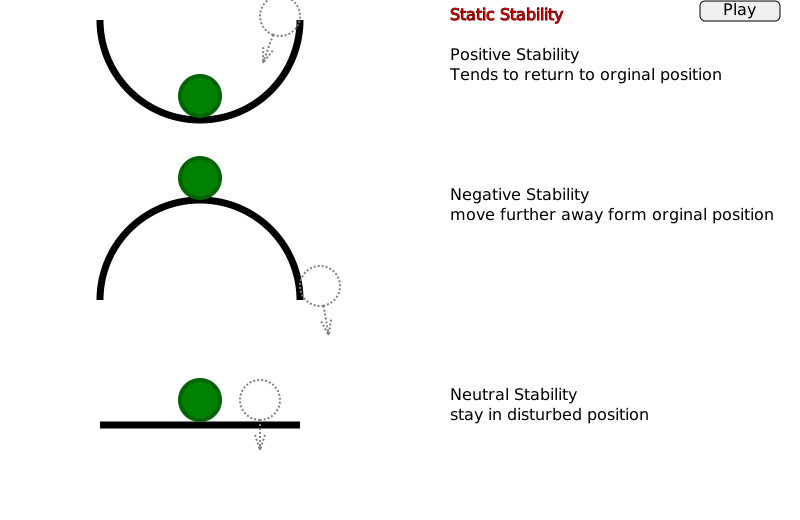
Static stability refers to the initial reaction of a body after being disturbed or displaced from a position of equilibrium. If it initially tends to return to its original position, it has positive static stability.
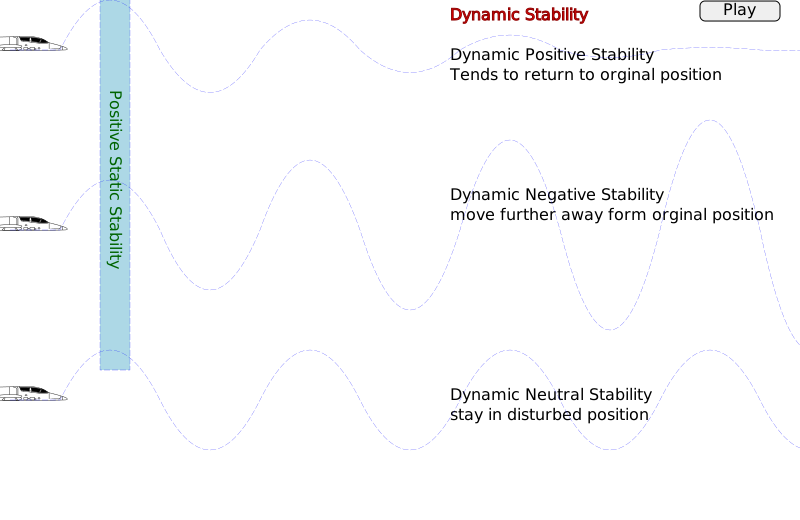
Dynamic stability relates to the subsequent motion of the disturbed body, once the static stability reaction has taken place. An aircraft will have dynamic stability if it eventually returns of its own accord to its original position of equilibrium.
22.26
Stability
Propeller solidity is an important design parameter for the axial flow impeller and is defined as the ratio of blade chord length to pitch.
 Anhedral aircraft with downward wings are typically used on large high-wing aircraft. It has a destabilizing effect to prevent the natural lateral stability becoming too strong.
Shielding:
Once the aircraft begins to side-slip, the trailing (up-going) wing, becomes shielded by the fuselage, which contributes to dihedral effect.
Keel surface:
Where the keel surface/fin area, is above the CG, the side slip force exerted on the fin, tends to right the aircraft back to level. The bigger the fin/tail, coupled with a low CG, the better the lateral stability.
Anhedral aircraft with downward wings are typically used on large high-wing aircraft. It has a destabilizing effect to prevent the natural lateral stability becoming too strong.
Shielding:
Once the aircraft begins to side-slip, the trailing (up-going) wing, becomes shielded by the fuselage, which contributes to dihedral effect.
Keel surface:
Where the keel surface/fin area, is above the CG, the side slip force exerted on the fin, tends to right the aircraft back to level. The bigger the fin/tail, coupled with a low CG, the better the lateral stability.
 Sweep-back:
Sweepback refers to the angle at which an aircraft’s wing is set back from a right angle to the body. Sweepback helps the aircraft gain lateral stability, therefore righting it if it is disturbed in roll.
Sweep-back:
Sweepback refers to the angle at which an aircraft’s wing is set back from a right angle to the body. Sweepback helps the aircraft gain lateral stability, therefore righting it if it is disturbed in roll.
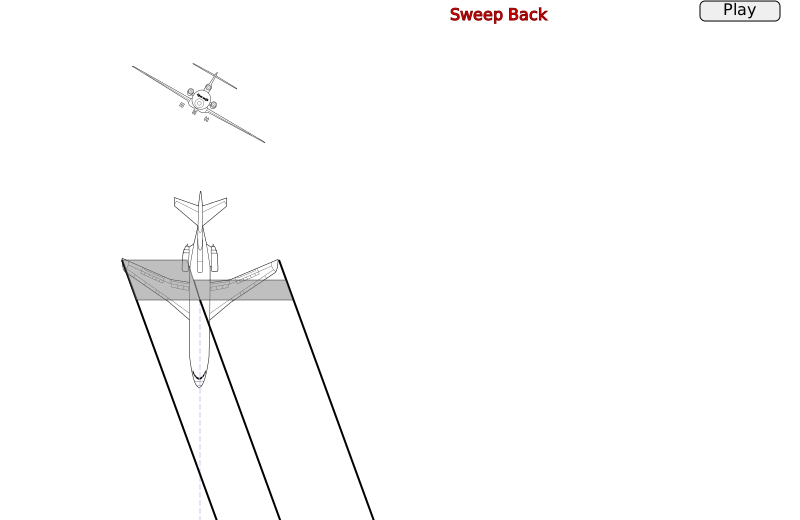

 In the diagram, you can see that when an aircraft rolls and slips, the relative airflow doesn’t meet the aircraft directly head on. This means, the effective span, and therefore the aspect ratio of each wing is different.
Aspect ratio = span / mean chord line
This means, the lower wing has a higher aspect ratio, and therefore produces more lift, this in turn raises the lower wing back to straight and level.
Wing position (Pendulum Effect):
High wing aircraft have a higher CG, thus when they are disturbed in roll, a moment is created between the forces of lift and weight, creating a righting moment.
This effect is not as strong in low wing aircraft.
This is also known as pendulum effect.
In the diagram, you can see that when an aircraft rolls and slips, the relative airflow doesn’t meet the aircraft directly head on. This means, the effective span, and therefore the aspect ratio of each wing is different.
Aspect ratio = span / mean chord line
This means, the lower wing has a higher aspect ratio, and therefore produces more lift, this in turn raises the lower wing back to straight and level.
Wing position (Pendulum Effect):
High wing aircraft have a higher CG, thus when they are disturbed in roll, a moment is created between the forces of lift and weight, creating a righting moment.
This effect is not as strong in low wing aircraft.
This is also known as pendulum effect.