6.12.4 Explain the effect of a change in mean sea level air pressure on the altimeterreading of a transiting aircraft.

6.12.4. Explain the effect of a change in mean sea level air pressure on the altimeter reading of a transiting aircraft. 

Transiting Aircraft from  Higher to a Lower QNH.  
-300ft1023hpa0ft1013hpa1000ft980hpa2000ft946hpa3000ft913hpa300ft1003hpa1000ft980hpa2000ft946hpa3000ft913hpa

When you transit from an area of Higher QNH than an area with a lower QNH and you do not adjust your altimeter sub-scale, your altimeter will “over read”. As in this case altitimeter will tell you 2,000ft, where in fact you have descended to 1,400ft. a lot closer to the ground.

Easiest way to recall this is, the altimeter acts like the atmosphere, low pressure is higher in the  atmosphere, so the altimeter will also read higher than your actual altitude.(Note; very dangerous)

Transiting Aircraft from  Lower to a Higher QNH. 

300ft1003hpa1000ft980hpa2000ft946hpa3000ft913hpa-300ft1023hpa0ft1013hpa1000ft980hpa2000ft946hpa3000ft913hpa

When you transit from an area of lower QNH than an area with a higher QNH and you do not adjust your altimeter sub-scale. Your altimeter will “under read”. As in this case your altimeter will tells you  2,000ft, where in fact you have climb to 2,600ft. 

Easiest way to recall this is, the altimeter acts like the atmosphere, high pressure is lower in the the atmosphere, so the altimeter will also read lower than your actual altitude

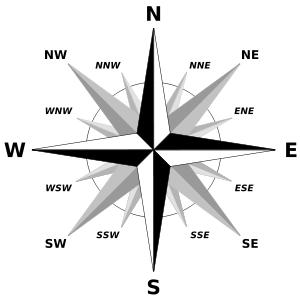
6.4.6(e) Define the inter-cardinal directions of the earth;

6.4.6(e)  The inter-cardinal directions of the earth; 
When talking about the inter-cardinal directions on the Earth, we use northeast (NE), southeast (SE), southwest (SW), and northwest (NW)


FlashCards 6.48

[vfr_FlashCards p1=”6.48″]

6.46.4 Calculate the expected fuel burn on a given leg.

Calculate the expected Fuel Burn on a given leg.

To calculate a Fuel Burn for a given leg, first we must work out the time of the given leg using the distance and ground speed; derived from the flight planning TAS and the local forecast winds.

We then work out the fuel burnt on that leg using our Fuel Burn per hour against the time for the given leg.

Eg: If we burn 20L an hour, and the flight leg is 30 minutes, we will burn 10L 

Workout how fast you are travelling.

To work out your speed you need to know first ….

1. Distance travelled.

2. Time taken.

In this example we have to calculate the speed of our aircraft across the ground, Lets say we have flown 34 nm in 14 minutes.

On the Wizz wheel, Distance is on the out side and time is on the inside.

1. Distance of 34 on the outside 

2. Time on the inside of 14 mins.

101011111212131314141515161617171818191920202121222223232424252530303535404045455050555560607070808090901. Outer Find Distance of '34'2. Inner lineup '14 Minutes'

Now we have Distance and Time Ratio setup.

3. Find the time of 60 / Hour on the inside (as time is on the inside).

4. Read off the speed of 146 the on outside. This is distance in an hour,thus your speed is 146 knots

101011111212131314141515161617171818191920202121222223232424252530303535404045455050555560607070808090901. Outer Find Distance of '34'2. Inner lineup '14 Minutes'4. Outer read off '146'3. Inner find '1 Hour'

FlashCards 6.16

[vfr_FlashCards p1=”6.16″]

6.14.2(i) Define Track Made Good;

6.14.2(i)  Track Made Good; 

Track Made Good (TMG) is the actual track or path the aircraft flies over the surface of the Earth. 

6.12.2(i) Define QNH.

6.12.2(i)  QNH. 

QNH refers to the current mean sea level pressure for the given day. 

When QNH is set, the altimeter will read altitude (above sea level) 

You can also set the altimeter subscale setting to QNH to obtain elevation when on the ground.

FlashCards 6.10

[vfr_FlashCards p1=”6.10″]

Measure distances up to 300nm ( 1%) on an appropriate chart.

6.6.6. Measure distances up to 300nm (1%) on an appropriate chart

To measure distance on a chart, first you must use an appropriate ruler with the appropriate scale. 

Then accurately measure (1% error margin) from the starting point of the route to the finishing point, reading off the length of the track or route against the scale on the ruler.