Our simple log process is just... 1. You enter your email (the one you use to correspond with the flying school) 2. we send you a link. 3. you click the link in your email 4, then you are all log in , ready to go. no password etc / simple as!
Estimate:
a)  a Heading change, using the 1:60 rule ( 2);
b)  a Heading change, using drift lines ( 2);
c)  a Heading to make good a reciprocal track;
d)  a Ground Speed change;
e)  an ETA change, using proportional method.
Describe the factors that affect the duration of twilight
With increasing latitude, the period of twilight increases. At the tropics the change from darkness to light and vice versa are somewhat abrupt or fast.
After sunrise in the tropics, the sun rises more steeply to the horizon than in the higher latitudes, where it rises at a more oblique angle.
When making a position report in relation to a bearing and distance, an accurate bearing to or from a position, place or navigation aid; with a distance gives an accurate position report.
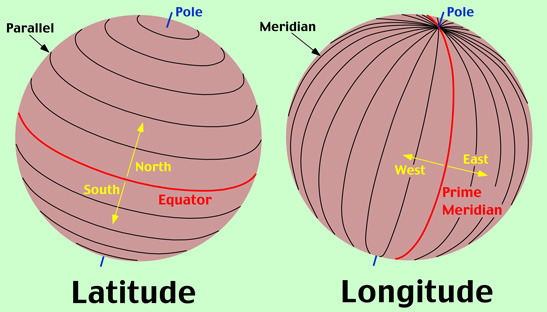
6.2.4(e) Define and identify on a diagram of the Earth:
Meridians of longitude;
Meridians of longitude form half of an imaginary great circle on the Earth’s surface, starting at the North Pole and ending at the South Pole, connecting points of equal longitude
Longitude describes the location of a place East or West from the Prime Meridian, a line which runs between the poles and through Greenwich, England; which acts as a datum.
Longitude increases as you leave the Prime Meridian (0 degrees) going East (0 to 180 degrees) and decreases as you head West (0 to -180 degrees), until they meet at 180 degrees.
Describe the method of operation of Primary RADAR.
Describe the method of operation of Secondary RADAR.
Primary RADAR works on the “echo” principal, where signals from the ground-based RADAR aerial strike an aircraft and scatter in many directions. Some of these will return to the Radar aerial.
The time taken between signals leaving the aerial and the “echo” being received is an indication of distance
Secondary Radar relies on a piece of equipment aboard the aircraft known as a “Transponder” which instantly sends a RADAR response signal back to the RADAR installation.
Time taken between signal leaving the aerial and the response being received is function of distance and location.