Explain how the friction layer affects the surface wind velocity.
Friction is proportional to surface roughness and acts opposite to the wind flow direction.
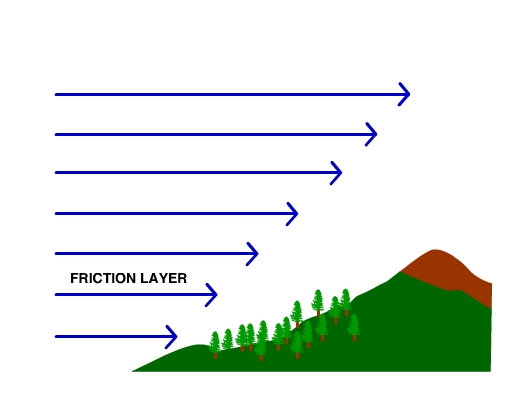
the friction layer has the effect to slow the surface wind velocity.
The Pressure Gradient Force is not affected by friction however Coriolis Force is. Coriolis Force is proportional to wind speed, so as friction causes wind speed to reduce the CF must also reduce
Describe the elements that influence the depth of the friction layer
The friction layer is determined by the roughness of the underlying surface and the speed of the wind blowing across it
Ocean – exerts little frictional drag on the wind not only because waves aren;t that big, but also beacuse the wave tend to travel with the wind and offer less resistance
Land mass – there is no give in the surface features, so trees, buildings hills and mountains have a much greater slowing effect on the wind. The turbulence generated by the wind flow affects a deeper layer of the atmosphere – to as much as 15,000 ft or more over large mountain ranges
Explain what is meant by the "friction layer"
The surface of the earth exerts a frictional drag on the wind flowing over it
Due to drag caused by irregularities such as hills, mountains and buildings, the speed at which the wind blows over the surface is slowed.
The tumbling, turbulent layer within which this slowing down occurs, is called the Friction Layer
Explain how the inter-relation between pressure gradient and Coriolis force determines the circulation around pressure systems.
The pressure gradient attempts to push air from the centre of the high to the centre of the low.
Coriolis force opposes pressure gradient, and acts towards the centre of the high.
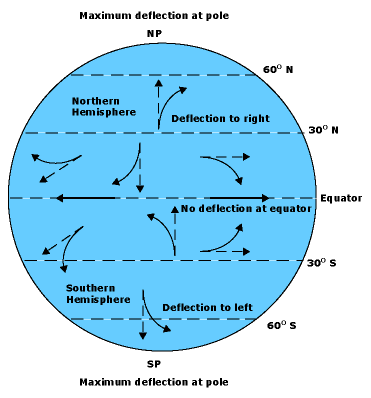
When these two forces are exactly equal and opposite, the wind blows on a straight path along the isobars.
When coriolis is stronger than pressure gradient the wind curves anticlockwise around a high
When coriolis force is weaker than the pressure gradient the wind curves clockwise around a low
State the units to describe wind speed
Wind is reported in knots (nautical miles per hour) and in degrees True when issued from Metservice
All wind directions used in aviation state the direction from which the wind is coming from
State the effect of wind speed on the strength of the Coriolis force.
If the earth were stationary the wind would be able to move directly from high pressure to low pressure (just like a bicycle tube) which would mean that the wind blows at right angles across the isobars from the centre of the high to the centre of the low.
But as the earth rotates 360 degrees in 24 hours, the consequence of this is that the wind is prevented from blowing from high to low – and instead blows parallel with the isobars
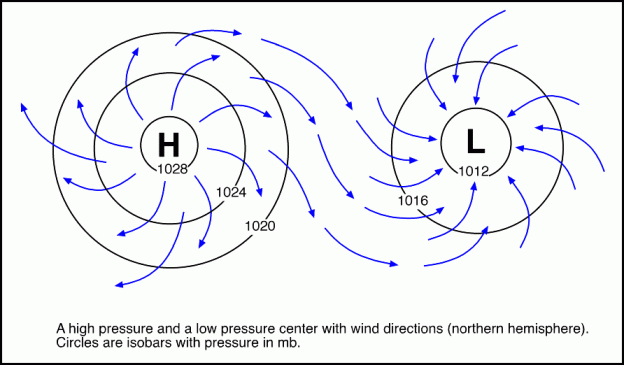
Flow pictured for northern hemisphere
List the three forces acting to generate wind at low levels
The three forces are;
1. Pressure Gradient
2. Coriolis Force
3. Friction
State the units used to describe wind direction with reference to a) forecasts issued by Metservice and b) spot winds relayed to pilots
a) Forecasts issued by Metservice
The aviation industry uses Magnetic wind directions, but observed and forecasts winds issued from Metservice are provided in degrees True. This is because meteorological data often covers large areas in which the Magnetic North changes significantly
b) Spot winds relayed to pilots by Air Traffic Control
Spot winds are supplied in degrees Magnetic, – however if they are passing you a wind from a METAR and or TAF the direction will be issued in degrees True
Define the “geostrophic wind”
The geostrophic wind is the wind that would result from a perfect balance of Pressure Gradient, and Coriolis Force when the isobars are straight.
Because the surface frictional force is not involved in the definition, the wind balance represents the real wind found above the friction layer wherever there are straight isobars drawn on a weather map.
The resultant wind flows parallel to the isobars and wind speed is controlled by the magnitude of the Pressure Gradient
List the three properties of the Coriolis force
1) It act at right angles and to the left of motion in the Southern Hemisphere’
2) It’s strength is proportional to the wind speed – the stronger the wind the stronger the Coriolis force
3) Its strength is proportional to the sine of the latitude – zero at equator and max strength at the poles