Explain why inversions and isothermal layers are atmospherically very stable;
A parcel of air lifted through the atmosphere must cool at either the DALR ot the SALR
When this parcel passes through an inversion its internal temperature will be cooling while the surrounding environment is warming up
If the lifting force were to cease its internal temperature will certainly be lower than the environment surrounding it – parcel will want to sink back into its starting position = stability
If a lifted parcel is passing through an isothermal layer the same process occurs except the temperature differences will not be as marked
Define the following…
‘
a) Inversion
The usual environmental lapse rate is such that temperature decreases with increasing height through the troposphere.
An inversion is a shallow layer where the opposite of this occurs – temperature increases with increasing height
b) Isothermal Layer
An isothermal layer is one through which temperature remains constant with increasing height
State the conditions needed for the conditionally unstable air to be forced to become unstable;
When forced to rise, conditionally unstable air may become unstable if certain conditions are met
To become unstable a sufficient depth of cloud must form – which results in the release of latent heat which will slowly destabilise the rising parcel of air
Air forced to rise -> subject to less Pressure -> Expands -> Cools
Continued cooling -> Condensation -> Cloud formation – Release of latent heat -> Destabilisation occurs
State the saturated adiabatic lapse rate (SALR).
SALR = 1.5 deg Celsius per 1000 ft
When air cools, its relative humidity increases and condensation will occur if cooling continues after the dew point temperature has been reached.
The condensation process releases Latent Heat
The Saturated Adiabatic Lapse Rate is the consequence of this heat being released; reducing the Adiabatic rate at which air cools
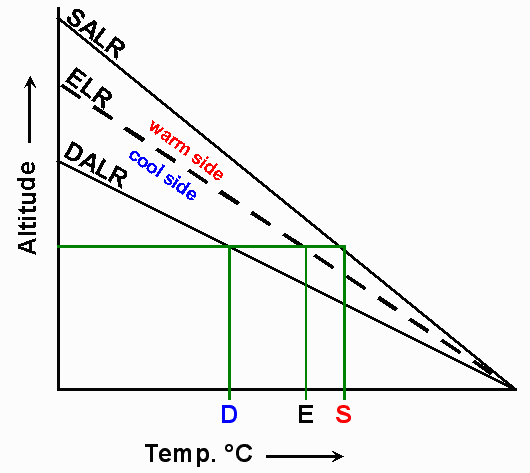
Explain how the relationship between the ELR and DALR can be used to determine the stability or instability of unsaturated air.
A stable situation is confirmed when the DALR lies below the ELR
The air is unstable when the DALR lies above the ELR
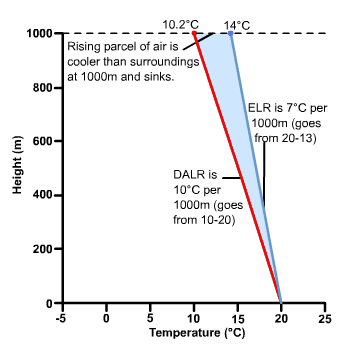
In this situation, the DALR is below the ELR, meaning that the air is stable.
State the dry adiabatic lapse rate (DALR).
DALR = 3 degrees Celsius per 1000 ft
Picture a parcel of air being forced to rise up the slope of a hill.
As it enters higher levels where the pressure is less, the parcel expands and then cools adiabatically. The rate at which this cooling takes place is about 3 degrees per 1000ft.
This rate applies to all parcels of rising or descending air provided the water vapour within it does not condense – ie air must remain “dry”
Interpret graphs of steep and shallow environment lapse rates (ELR) including inversions and isothermal layers.
Steep ELR
A large decrease in temperature with height
ie found in the lower layers of the atmosphere on a hot summer’s day
Shallow ELR
This is a small decrease in temperature with height – eg in air over the sea which does not warm greatly at low levels
Explain the adiabatic process;
When a parcel of air is forced to rise through the atmosphere its internal temperature decreases
– with rising there is less pressure
– which causes it to expand,
– followed by cooling
Because the air molecules are cooler, they have more room to move about so they collide less frequently and therefore generate less heat – this process is the ADIABATIC PROCESS
The second lapse rate occurs when the parcels of air rise or descend, so that their volumes change as the pressure around them changes
The process involved is the Adiabatic process
A change in temperature, takes place while no heat energy is given to or taken from the surroundings
Explain how the environmental temperature and dew point lapse rates are found;
These measurements are derived from data from a weather balloon aloft, which carries an electronic instrument package called a “radiosonde”
Temperature, dew point and pressure are measured every minute’ then the data is radioed back to a ground station
The data gathered is then plotted on a graph called a Tephigram
Additional data can be gathered from aircraft and satellites
Describe what is meant by "environmental lapse rate" (ELR).
The Environmental Lapse Rate (ELR)
is the rate of decrease of temperature with altitude in the stationary atmosphere at a given time and location.
The average ELR is around 2 deg per 1000 ft as per ISA standard
Thins can change quickly over time and vertical distance with increasing temperature with increasing height (inversions) and isothermal layers
For example;
International standard atmosphere (ISA) has a Environmental lapse rate of 1.98 °C/1,000 ft,
often round to 2 °C/1,000 ft.
| Altitude |
Temperature |
| Sea Level |
15 °C
|
| 1000 ft |
13 °C |
| 2000 ft |
11 °C |
| 3000 ft |
9 °C |
| etc .. |
|