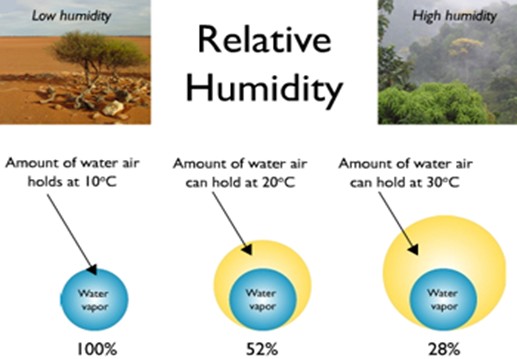
State the two factors that determine the stability of air.
Whether the air is stable or unstable depends mainly on these two factors:
The temperature lapse rate of..
large air masses or the Environmental.
The adiabatic lapse rate
as a parcel (balloon) of air moves up it cools.
Stable
If parcel of air is colder than the environment. then parcel will sink or return to down to original location.
Unstable
If parcel of air is warmer than the environment. then parcel will continue to rise.
Describe how the stability of a rising or sinking parcel of air is determined by its temperature compared with the temperature of the surrounding environment;
If the temperature inside the parcel of air becomes warmer than the surrounding environment during lifting it will continue to rise when the lifting force ceases because the air inside is less dense ie; entering an unstable atmosphere
If the air inside the parcel becomes colder than the environment during the lift the parcel will sink when the lifting force ceases because it will be denser ie; risen into a stable atmosphere
The temperature changes within a rising parcel of air are not necessarily the same as those temperature changes in the surrounding environment
Explain what is meant by:
a)  stable air;
b)  unstable air;
c)  neutrally stable air.
a) Stable Air
Air is considered stable when a parcel of air is forced up or down from its current position or height, and without assistance from other outside influences, returns to its original position.
b) Unstable Air
If a parcel of air has no tendency to return to it’s original position after a disturbance, and instead moves further away it is said to be unstable.
c) Neutrally stable air
If following a disturbance a parcel of air has no tendency to return to original position or move further away it is said to be neutrally stable
Explain how temperature, relative humidity and Dew Point values can be used to indicate differences in water content of air.
Relative Humidity and Dew Point are useful and practical indicators of the “dampness ” of air and the likelihood of cloud / fog formation and precipitation.
VFR flying can be more difficult / unsafe if the resulting cloud base is very low.
Explain the effects on aircraft and engine performance of:
a)  air density
b)  air moisture content.
The mass of a molecule of water vapour is less than the mass of a molecule of dry air – in a given volume of air an increase in water content decreases the total mass.
Mass of air is proportional to its density; the greater the water content of air the less it’s density.
When the water vapour content of air increases the RH goes up and the Dew Point goes up.
Explain the effect of moisture content of air on the Dew Point.
When the water vapour content of air increases, the Relative Humidity goes up and the Dew Point goes up also. If moisture is removed the Dew Point goes down
The air temperature is always equal to or more than the Dew Point temperature
By comparing the Dew Point temperature with the air temperature we have a measure of the water content of the air
The closer the temperatures are to each other the nearer we are to saturation and then condensation occurring
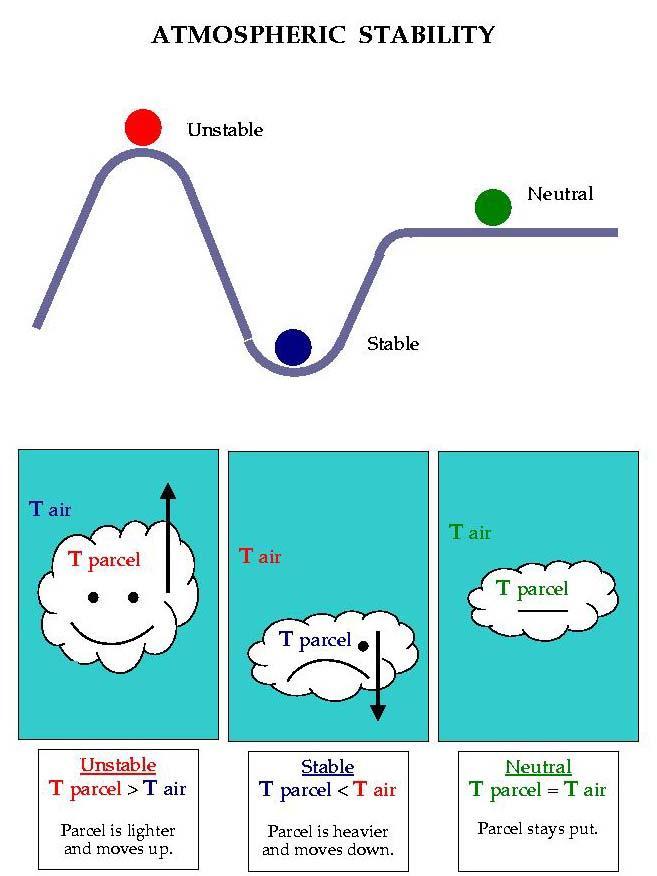
Explain how the temperature of air influences its capacity to hold water vapour
Air appears to behave lie a sponge
When the air temperature increases the sponge grows and the air can hold more water vapour
When the temperature falls the sponge shrinks and the air can hold less water vapour
“The warmer the air parcel the more water vapour it can hold”
8.16.6 Define the term 'Dew Point'.
The Dew Point is the temperature at which the air becomes saturated ie the Relative Humidity reaches 100%
Dew Point temperature is the temperature to which a parcel of air must be cooled at constant pressure to become saturated
Explain the effect of changes in temperature and moisture content of air on relative humidity.
When moisture is added to the air at a given temperature, the relative humidity goes up.
When moisture content decreases relative humidity goes down.
Explain what is meant by relative humidity.
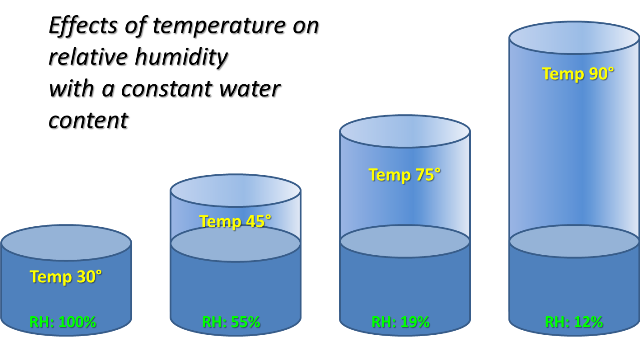
Relative humidity is the amount of water vapour present in the air.
It is the amount of water vapour the air CAN hold, expressed as a percentage.
A change in the relative humidity in the atmosphere can be casued by
– a change inb water vapour content in a parcel of air or
– a change in temperature