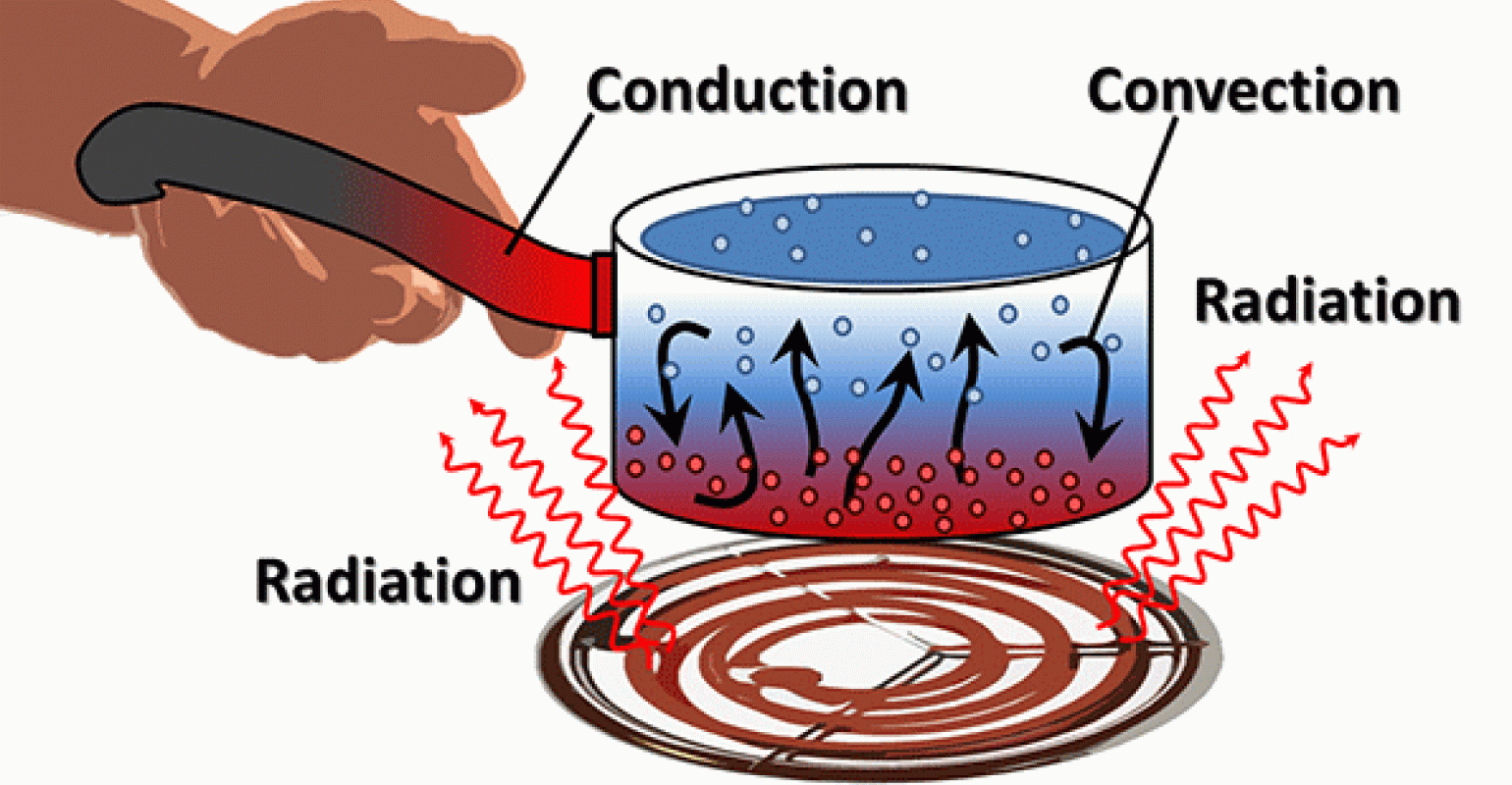
Describe the processes that change the physical state of moisture and explain how latent heat is involved in each transformation.
liquid water -> water vapour – evaporation – latent heat required
water vapour -> liquid water – condensation – latent heat released
ice -> liquid water – melting – latent heat required
ice -> water vapour – sublimation – latent heat required
liquid water -> ice – freezing – latent heat released
water vapour -> ice – deposition – latent heat released
State the effect of the following on the rate of evaporation:
a)  air temperature;
b)  moisture content of air;
c)  atmospheric pressure;
d)  the wind.
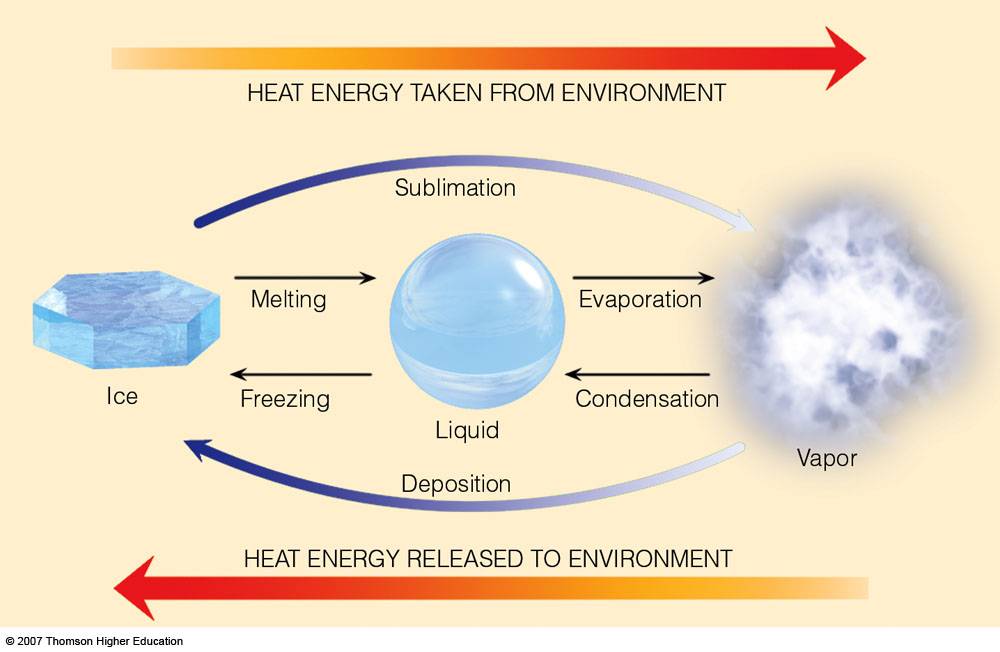
Evaporation is the change from liquid water to water vapour.
The ability of air to absorb water as a vapor depends mainly on the air temperature.
The warmer the air, the more water vapor it can hold; and the colder the air the less vapor it can hold.
The rate of evaporation will be greatest when the air is warm and dry, the pressure is low and a wind is blowing.
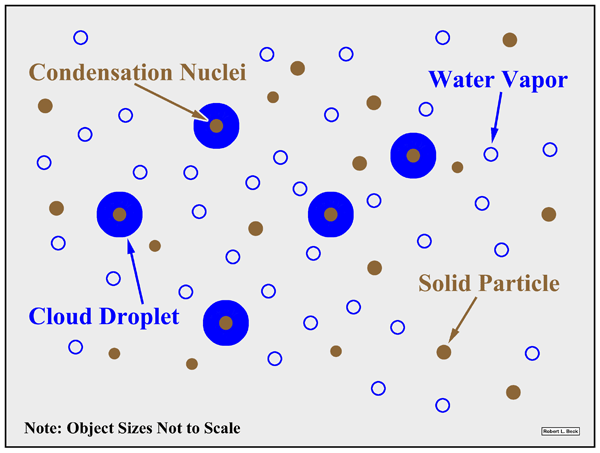
Explain the function of condensation nuclei during condensation.
The condensation process, requires the presence of condensation nuclei such as salt, carbon, soot etc around which the water vapour can cling to which creates liquid water drops.
In a dusty environment, there is more condensation compared to a clean environment which has delayed condensation.
State the significance of the reease of latent heat into the atmosphere during cloud formation
Clouds form through the process of condensation and this releases latent heat into the atmosphere
The released heat destabilises the atmosphere if enough cloud is formed and enough heat generated, it can force the atmosphere to become unstable. Now the clouds can grow unchecked turning into cumulonimbus or thunderstorm clouds
Name and explain the processes by which water vapour enters the atmosphere;
Water vapour enters the atmosphere through two distinct processes
1) Evaporation – the reverse process to condensation – water changes naturally back into water vapour in the environment from puddles, lakes etc
2) Transpiration – moisture is carried through plants from roots to small pores on the leaves where it is released to the environment
Collectively the above are called Evapotranspiration all of which takes place from the surface of the earth (apart from evaporating clouds)
When water changes between its 3 states of ice, water and water vapour, the processes involved must include the uptake or release of latent heat.
Latent – generally means “hidden” – heat is the heat energy needed to convert ice to liquid, liquid to vapour and /or ice directly to vapour without a change in temperature
8.16.12 Describe each of the following processes with regard to the changes of state of water:
(a) condensation;
(b) evaporation;
(c) deposition;
(d) sublimation;
(e) melting;
(f) freezing.


 a) Condensation is the change from water vapour to liquid
e.g. cloud or fog forms from this process
 b) Evaporation is the change from water liquid to vapour
The ability of air to absorb water as a vapour depends on the temperature of the air;
the warmer the air the more vapour it can hold and the colder the air the less vapour it can hold
c) Deposition is the process of water vapour to ice, by-passing the liquid state
e.g. – seen on a frosty night when ice covers the car windshield
 d) Sublimation is the by-passing of the liquid state, when ice melts into vapour
e.g. – ice changes directly to vapour
e) Melting is when ice changes into liquid water
f) Freezing is when liquid water changes into ice
g) Latent heat is in all changes of state, no matter which way latent heat is involved.
It is the energy required or given off to make the change  – it does not affect the temperature of the substance that is changing, only that of the surrounding air or mass.
Describe the diurnal variation of surface air temperature and explain the effect of different types of surface on this variation.
Diurnal means “taking place in 24 hrs“
Because the sun shines for only half-ish of the day, the Earth’s surface can warm the air to any extent only during this time; thus a variation develops where temperatures are warmest during early afternoon after maximum solar energy has been received, and temperatures are coldest at the end of the night around dawn.
The degree of temperature variation depends on the type of earth surface as well as albedo, cloud, sun angle and presence of wind.
Define albedo.
Albedo means “whiteness”
It is used to describe the ability of a given surface to reject incoming solar radiation
For example; snow fields have a high albedo, therefore are capable of almost total rejection
Describe the process of:
a)  Conduction;
b)  Convection
c) Advection
a) The Earth’s surface warms air particles in touch with the surface through conduction
b) When air particles have been warmed they expand, mix and rise and through convection, warming higher layers of air
c) Advection is horizontal heat transfer by wind eg – warm airflow from the tropics