6.12.2(a) Height;
Height is the vertical distance above a datum, such as the ground.
6.12.2(a) Height;
Height is the vertical distance above a datum, such as the ground.
6.10.2(a) Ground position;
Ground position is the position of an object in relation to the Earths surface; with regards to an aircraft, this position will be directly below the aircraft.
6.8.2(a) Knot (kt);
Knots are used as a measurement of speed.
1 knot =
1 nautical mile per hour (by definition),
1.852 kilometres per hour (exactly),
1.151 miles per hour (approximately).
6.6 Distance on the Earth
6.6.2 Define:
(a) statute mile;
(b) nautical mile;
(c) kilometre;
(d) metre;
(e) foot.
6.6.4 Calculate the conversion between a statute mile, a nautical mile and a kilometre.
6.6.6 Measure distances up to 300nm (± 1%) on an appropriate chart.
6.8 Speed and Velocity
6.8.2 Define:
(a) a knot (kt);
(b) ground speed (GS);
(c) indicated airspeed (IAS);
(d) calibrated airspeed (CAS);
(e) true airspeed (TAS).
6.8.4 Explain the difference between speed and velocity.
The cardinal directions of the earth;When talking about direction over the Earth’s surface, we use North, East, South, West. | 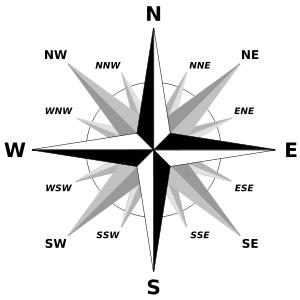 |
To indicate direction in aviation we use 360 degrees.North = 360° , East =90° South=180° West = 270° |
In the Bay of Plenty area here in New Zealand, the difference is
20 degrees between True North and Magnetic North.
So iyou read off your paper map (True)
and then fly that heading in your Aircraft (Magnetic) .
There is a rule called the 1 in 60 Rule where in
short a 1-degree error means that you would be 1 nautical mile off track after 60
nautical miles.
So if you intend to fly to a destination
60 nautical mile away you will miss it by 20 nautical miles
In simple terms, a risk of becoming lost, so
what you are going to learn here will probably mean you won’t make this mistake and
others
Under rule 91.529, a person must not operate a NZ Certificate of Registration
aircraft without an ELT(AF) unless it is:
1. When the aircraft is ferried to a place where the automatic ELT(AF) is to be installed provided no passengers are carried.
2. When the aircraft is to be ferried from a place where ELT repairs or replacement cannot be made to a place where they can be made provided no passengers are carried.
3. For a period of seven days when the automatic ELT is inoperative, and a portable ELT is accessible to each person on board the aircraft
This rule does not apply to the following aircraft:
1. An aircraft with no more than one seat if the pilot is equipped with an Emergency
Locator Transmitter (Survival) ELT(S) or Personal Locator Beacon (PLB).
2. A glider or microlight aircraft if at least one person carried in it is equipped with
an ELT(S) or PLB.
3. A glider or powered aircraft, including a microlight aircraft, that is equipped with
no more than two seats, if the glider or powered aircraft is operated not more than 10
nm from the aerodrome from which the glider or powered aircraft took off.
4. A manned free balloon.
(a) A person must not operate an aircraft without an ELT(AF) installed in
the aircraft except as provided in paragraphs (b), (d), and (e), rule
121.353(b), and rule 129.109.
(b) An aircraft may be operated without an ELT(AF) installed if:
(1) The operation is to ferry the aircraft from the place where the
operator takes possession of the aircraft to a place where an
ELT(AF) is to be installed; and
(c) Despite rule 91.501(4), an aircraft may be operated with an
inoperative ELT(AF) if;
(3) The operation is to ferry the aircraft from a place where repairs or
replacement of the ELT cannot be made to a place where the
repairs or replacement can be made; and
(d) Despite rule 91.501(4) and paragraph (a), an aircraft may be operated
without an operable ELT(AF) for a period of not more than 7 days if the
aircraft is equipped with an ELT(S) or PLB that is accessible to any person
on board the aircraft.
(e) Paragraph (a) does not apply to the following aircraft:
(1) An aircraft that is equipped with no more than 1 seat if the pilot
is equipped with an ELT(S) or PLB:
(2) A glider or microlight aircraft if at least 1 person carried in the
glider or microlight aircraft is equipped with an ELT(S) or PLB
(3) A glider, or powered aircraft, including a microlight aircraft, that
is equipped with no more than 2 seats, if the glider or powered
aircraft is operated not more than 10 nm from the aerodrome
from which the glider or powered aircraft took off:
(4) a manned free balloon.
(f) A holder of a certificate of registration for a New Zealand registered
aircraft that is equipped with an ELT(AF), or carries an ELT(S), EPIRB, or
PLB that operates on 406 MHz must not operate the aircraft unless: