22.22.2
Explain how the required turning (centripetal) force is generated.
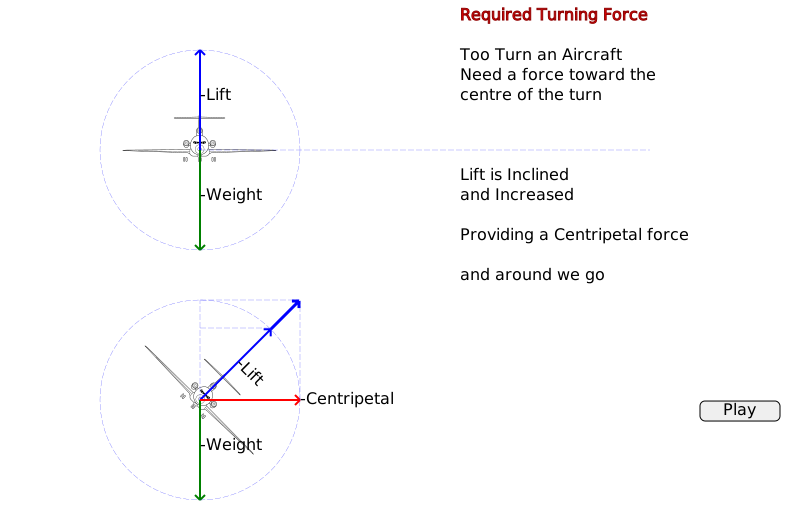
22.22.2 Explain how the required turning (centripetal) force is generated.
22.20.16
Describe the effect of:
(a) weight on glide angle and best glide speed;
(b) wind on net flight path.
(a) The weight of an aircraft has no effect on glide angle. A decrease in weight will mean the angle of attack for best L/D ratio will occur at a slightly lower airspeed. Although the range is not altered the rate of descent will be slightly lower and the time taken to reach the ground will be longer.
(b) A headwind will reduce the distance travelled over the ground. It does not affect the glide distance through the air mass or the rate of descent

22.20.14
Explain the connection between L/D ratio, glide angle, airspeed and gliding range.
The glide angle at any speed is determined by the L/D ratio. If the L/D ratio is high the glide angle will be shallow. It the L/D ratio is poor the glide angle will be steep
If the glide speed is higher or lower than stated in the flight manual the L/D ratio will not be as good and the glide angle will be steeper
Flying the aircraft at the recommended glide speed will maximise the glide range. Any other speed, faster or slower will affect the glide range.

22.20.12
Identify the forces acting in a glide and a steady power-on descent.
When the aircraft is in a steady glide, weight acts vertically downwards, this causes a forward component of weight to be generated. This provides a force that helps pull the aeroplane down towards the ground

22.20.10
Explain the factors affecting climb performance (power applied, airspeed, flap and/or undercarriage extension, weight, altitude, temperature, manoeuvring, and wind - in relation to net flight path).
Power applied; Reducing power reduces climb performance. This is because the excess power required is reduced. Both climb rate and angle of climb will be reduced
Airspeed; Flying at any speed other than best rate speed will reduce climb performance.
Flap and/or undercarriage extension; Extending flap, particularly full flap will decrease climb performance, because for almost all aircraft the L/D ratio is reduced and the power required to maintain any speed is increased
The angle of climb will be reduced with any flap extended, because there is an overall poorer L/D ratio. Some aircraft flight manuals recommend flap for takeoff. This is to minimise the time the aircraft spends on the ground
If an aircraft with retractable undercarriage is left with the undercarriage extended the drag is increased and climb performance will be reduced
Weight; Increasing aircraft weight will reduce climb performance. The power required to maintain any airspeed in level flight increases with weight. Therefore there is less excess power available for climb
Altitude; The decrease in air density as altitude increases decreases performance in both the engine and aerodynamically
Temperature; If the air temperature is higher than standard climb performance will be reduced
Manoeuvring; Any manoeuvring while the aircraft is in the climb will absorb some or maybe all of the excess power available reducing climb performance
Wind; A headwind or tailwind will affect the climb angle over the ground but not the rate of climb
q
22.20.8
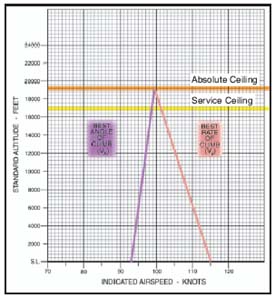
Define absolute ceiling and service ceiling.
Service ceiling is the altitude at which the aircraft can still maintain a climb at 100 feet per minute.
Absolute ceiling is the altitude at which the aircraft is no longer capable of climb.
22.20.6
State what the Vx and Vy speeds are and differentiate between these speeds and the normal climb speed.
Vx is also known as Maximum angle of climb. It is the airspeed where the aircraft will climb at it’s steepest possible angle. This speed is used where obstacle clearance is an issue.
Vy is also known as Maximum rate of climb. This airspeed is used to gain the most altitude in the least amount of time.
The normal climb speed also known as cruise climb is used when climbing long distances for cross countries etc. It has a lower climb rate than Vy but it has a lower nose attitude which aids cooling and gives better visibility.

22.20.4
Given typical power required and power available curves, explain:
(a) how a curve of excess power available (EP) can be derived;
(b) where the speeds for maximum rate of climb, and maximum angle of climb occur on the EP curve.
(a) A Power required/ Power available curve is derived by flight testing the aircraft and measuring the results.
(b) The speed for maximum rate of climb is the point on the Power available/ Power required graph where there is the greatest distance between the two curves.
The speed for maximum angle of climb is a line drawn from the origin of the graph tangentially to the Power required curve. Where the two touch is maximum angle

22.20.2
Identify the forces acting in a steady climb.
By understanding these forces you can understand the climb and get the best performance out of the aeroplane
Weight acts towards the centre of Earth, Due to the angle of the flight path the weight now acts towards the rear of the aircraft. This is similar to a car rolling backwards down a hill. A portion of weight acts opposite to lift as seen on the diagram. This is less than the total weight of the aircraft.
Drag is still acting on the aircraft. It is similar in size to straight and level flight. Thrust must be equal to
drag, and must be increased to overcome the rearward component of weight so the aircraft can climb. In a steady climb the forces are in equilibrium.

L<W
T=D + RCW
Given typical power available and power required curves, explain:
(a) the maximum and minimum speeds for level flight;
(b) the effects of increased weight and altitude.
(b) Weight affects the aircraft because every weight increase requires a higher angle of attack to maintain level flight. This has the effect of moving the power required curve up as increased power is required to maintain level flight at all speeds
Altitude also has an effect, If the aircraft is flown at a constant IAS as altitude is gained, TAS is going to have to increase. Because Power = Drag X TAS this means for a constant IAS any increase in altitude will require an increase in power
Also the power available will be decreasing as altitude increases. Eventually the lines on the graph will come together and maximum performance will have been reached