22.16.12
Describe how the following factors affect stalling speed:
(a) aircraft weight;
(b) load factor;
(c) power;
(d) altitude;
(e) the use of flaps and slats;
(f) contamination of the wing surfaces.
(a) As the weight of the aircraft increases the stall speed will increase
(b) An increase in load factor will increase the stall speed
(c) Use of power will lower the stall speed
(d) Altitude has no effect on the stall speed in terms of IAS it only affects TAS
(e) Use of flaps and slats will lower the stall speed
(f) Contamination of the wing surfaces will cause a higher stall speed. Damage to the leading edge of the wing will usually have a similar effect
22.16.10
Explain the standard recovery from the stalled condition.
Recovery from a stalled condition is as follows
1. Full power
2. Check forward to break the stall
3. Once the aircraft is unstalled and the airspeed is increasing raise the nose to the climb attitude
22.16.8
Describe the changes in the airflow over the wing, movement of the CP, and aircraft attitude as the point of stall is reached.
When the aircraft reaches the point of stall the air will no longer be able to flow over the wing

The centre of pressure moves forward as angle of attack increases until the point of stall. At that point the centre of pressure moves rapidly aft.
The attitude of the aircraft at the stall will be a high nose attitude. Once the aircraft has stalled the nose will pitch down.
22.16.6
Describe typical symptoms and other indications of the approach to the stall.
The typical symptoms of a stall are;
- A high nose attitude
- A low airspeed
- The flight controls will be sloppy and a lot of movement will be required
- The elevator will be almost if not all the way back, nose up
- The aircraft may experience buffeting, depending on the configuration
- The stall warning will be sounding (if fitted)
- It will be quiet in the aircraft
22.16.4
Explain basic stall speed and relate it to the lift formula.
The basic stall speed of the aircraft is the speed at which it can no longer maintain level unaccelerated flight, with the flaps up and the throttle closed.
Lift=CL1/2ρV2S
Ignoring (S) because we can assume wing area to be fixed, we can say
lift=Angle of attack X Airspeed
This means we can say that at the stalling airspeed the angle of attack will be at maximum.
Any increase in angle of attack will cause lift to reduce, which will mean the aircraft will start descending and the aircraft will ultimately stall.
22.16.2
Explain the stalled condition of an aerofoil.
When an aircraft stalls the amount of lift a wing can generate is substantially reduced. The wing can generate lift up until an angle of approximately 15-16° angle of attack. At this point the airflow is no longer able to smoothly flow over the wing and the lift production reduces. The CP moves rapidly aft and the aircraft will then usually pitch nose down.
This helpful for us because we can therefore work out when the aircraft will stall and why.
22.14.22
Describe the methods of providing mass balance.
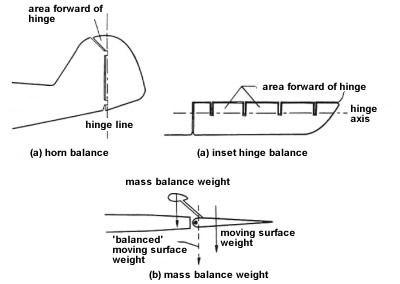
Mass balancing can be achieved in a number of ways.
The first is to put the mass in the horn balance. This is a convenient place for it and it is out of the airflow.
The second is to put it forward of the hinge line of an inset hinge line control surface. This is common on an aileron.
The final method is to use an external mass balance that is exposed to the airflow and is forward of the hinge line. This method has the highest drag.
22.14.20
Describe and explain flexural and torsional flutter.
All structures bend and twist under load; the wings and fuselage will bend and twist the same as any other structure. It is noticeable on most large transport aircraft. The wingtips can move several metres. Even in small aircraft the structure will move to some extent, even though it may not be noticeable.
If a wing is subject to a transient upward and downward bending motion, maybe due to turbulence, aileron flutter may occur if the centre of gravity of the control surface is some distance behind the hinge line and because of inertia it lags behind the outer wing in it’s movement up and down. When this happens the changes in camber of the outer wing, which are caused by the lagging aileron magnify the flexing of the wing caused by the original oscillation and may make it self generating also known as flutter. This is called flexural aileron flutter.
The other affect that can occur is that the wing twists about the torsional axis, this is called aileron reversal. As the aileron is moved down to raise the wing, the upward force at the rear of the outer wing can cause the leading edge to twist downward such that the overall angle of attack of the outer wing is reduced. The effect will be the opposite on the other wing and this will cause the aircraft to roll in the wrong direction.
Aileron reversal can be reduced by making the wings torsionally strong enough – and another common method used in large transport aircraft is to use spoilers for roll control at high speeds.
22.14.18
Explain the purpose for mass balancing.
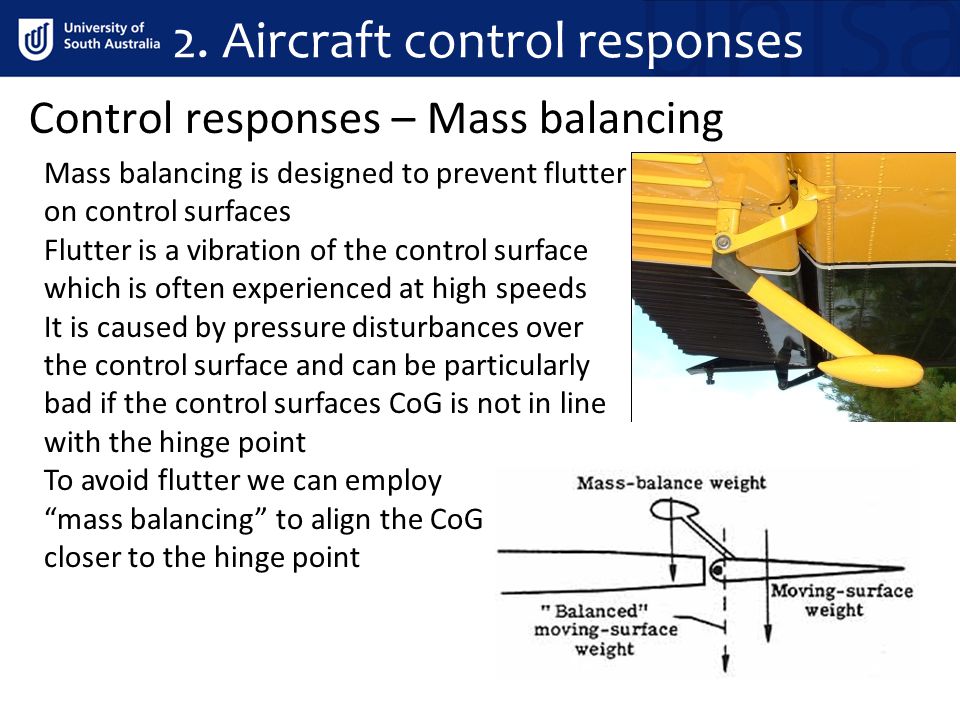
Mass balancing is necessary on control systems that are prone to flutter. This is done by adding mass forward of the hinge line to bring the centre of gravity at or close to the hinge line. This decreases the tendency for the control surface movement to lag behind any flexural movement of the wing, reducing the risk of flutter.