22.14.16
Differentiate between a balance tab and an anti-balance tab.
There is a difference between balance and anti-balance tabs. Balance tabs provide a reduction in the load the pilot feels. Anti-balance tabs actually enhance control feel.
Anti-balance tabs are a feature of the “Stabilator” or full flying tailplane. As the CP of the control surface is very close to the hinge line there is very little control feel when moving the controls. The anti-balance tab provides this feel.

22.14.14
Describe the main methods for achieving control balance.
qThe main methods of achieving control balance are, Inset hinges, Horn balance and Balance tabs
Inset Hinges are a method of balancing control surfaces where the hinge line is moved behind the control surface leading edge. This reduces the distance between the hinge line and the CP, this will mean the control forces will be reduced. Also because of the position of the hinge, the leading edge of the surface will be deflected into the airflow when moved by the pilot. The airflow accelerates around the nose of the control surface when it protrudes which causes a decrease in pressure in that area which results in the Cp of the control surface moving further forward, reducing the moment arm. This is effectively an aerodynamic force acting ahead of the hinge line which helps to keep it deflected.
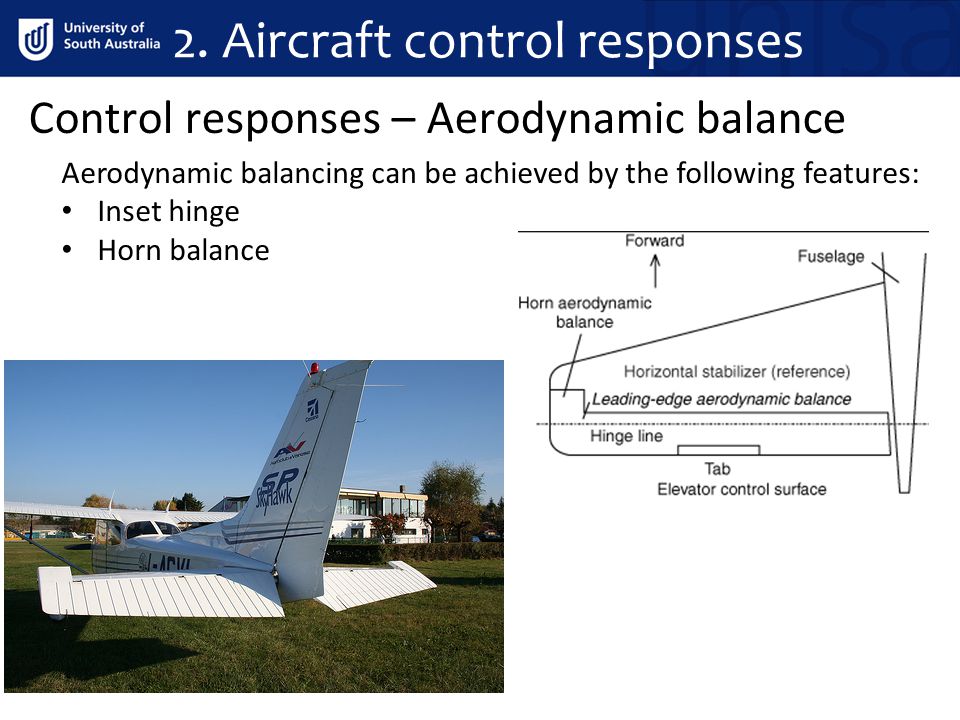
Horn Balance is achieved when a control surface is designed such that a portion of the surface protrudes ahead of the hinge line. The horn can be shielded or unshielded. Both types work on the same principal as the inset hinge line. As it is ahead of the hinge line it’s effect is to move the CP of the surface closer to the hinge line.
The designer must be careful not to bring the CP to close to the hinge line as this will reduce control feel, possibly to the point where the aircraft is unflyable. If the CP moves forward of the hinge line control reversal may happen. This is known as aerodynamically overbalanced.
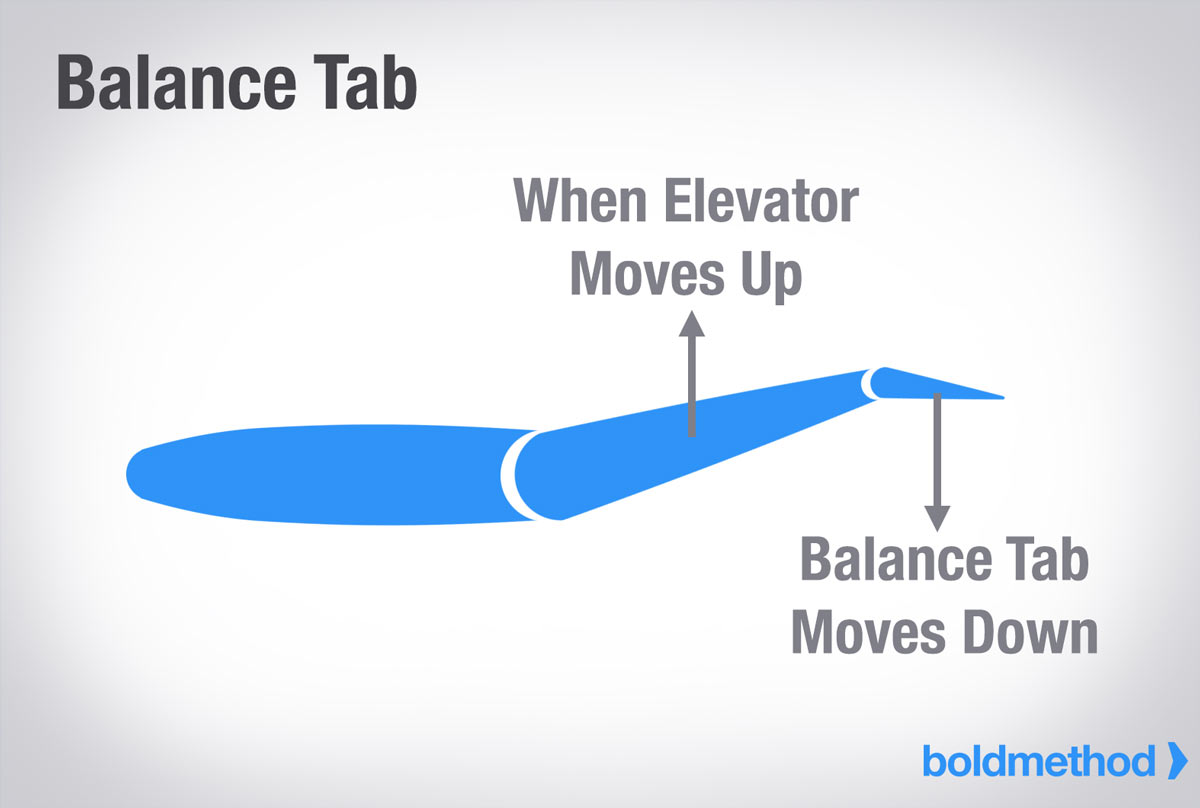
Balance tabs are a feature of conventional tailplanes. It is sometimes incorporated as a part of the elevator. It is set up so that when the elevator moves it will move in the opposite direction.
If the pilot moves the control column back and raises the elevator the balance tab moves down. This generates a small upward force that helps move the elevator up. This reduces the control force required by the pilot.
22.14.12
Explain the reason for aerodynamic balancing of control surface
Deflecting a control surface such as the elevator will cause a force in the opposite direction that opposes it’s deflection. This will cause a moment to act about the hinge line which tries to return it to it’s original undeflected position. The pilot has to add pressure against this force to overcome it and feels this as stick force.
The force produced by the deflected control surface acts through the centre of pressure of that control surface The greater the distance between the CP of the surface and the hinge line the greater the stick force
By altering the design of the surface it is possible to control the forces imparted to the pilot, methods for providing aerodynamic balancing include the use of inset hinges, horn balances and balance tabs
22.14.10
Explain the basic principles of trim tabs, and describe the correct method of using trim controls.
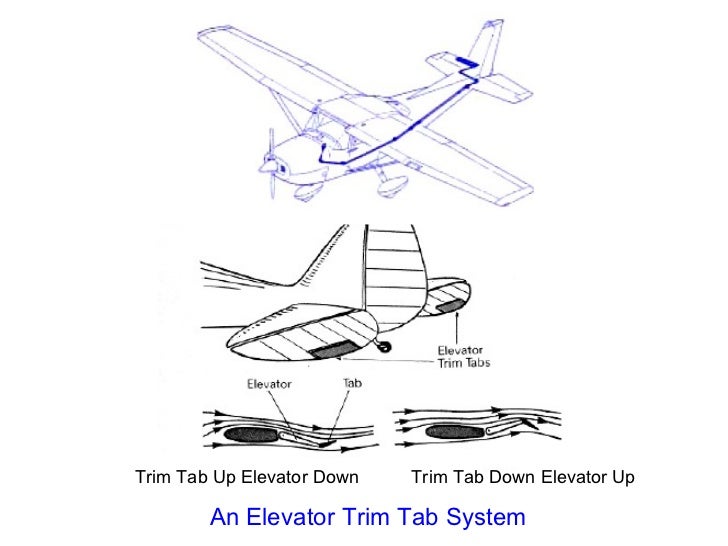
Trim tabs are used to balance flight control loads. Moving the trim tab will relieve flight control pressures for the pilot.
If the pilot is holding forward pressure on the control column the they will need to move the trim up – or forward in the case of electric trim which will relieve pressure. If the pilot is holding back pressure they will need to trim down or back to relieve pressure.
22.14.8
Describe the effects of airspeed and slipstream on control effectiveness.
Changing the airspeed of the aircraft will change the control effectiveness of the aircraft. As the speed increases the controls will feel stiffer and more effective. Slowing, they will be less effective and need greater deflection to achieve the same control response.
Slipstream will only affect the rudder and usually the elevator. The ailerons are unaffected as they are outside the influence of the slipstream. Thus opening the throttle and increasing the slipstream will make the rudder and elevator more effective.

22.14.6
Identify and explain:
(a) the secondary effect of aileron;
(b) adverse yaw and methods used to counteract it;
(c) the secondary effect of rudder.
| Plane |
Axis |
Control |
Primary effect |
Further effect |
|
|
|
|
|
| Roll |
Longitudinal |
Ailerons |
Roll |
Yaw |
|
|
|
|
|
a) The secondary effect of aileron is to yaw the aircraft.
b) Adverse yaw is the undesirable tendency for an aircraft to yaw in the opposite direction to the turn.
We can counter this by using coordinated aileron and rudder whenever we roll the aircraft.
As lift acts at 90′ to the relative airflow, the upper wing will have a higher RAF, therefore produce more lift and more drag.
c) The secondary effect of rudder is to roll the aircraft, in the same direction as the roll.

Another factor affecting adverse yaw, is aileron drag. This is when the ailerons are deployed (A/C is in a roll) and the upgoing wing is producing more lift, therefore more drag (you don’t get something for nothing) which causes a yawing moment in the direction of the upgoing wing.

22.14.4
Explain how control in pitch, roll, and yaw is achieved.
| Plane |
Axis |
Control |
Primary effect |
Further effect |
|
|
|
|
|
| Pitch |
Lateral |
Elevator |
Pitch |
|
| Roll |
Longitudinal |
Ailerons |
Roll |
Yaw |
| Yaw |
Normal |
Rudder |
Yaw |
Roll |
The first axis to deal with is Pitch. Pitch is controlled with the elevator through the lateral axis. Pushing the control column/stick down the nose will pitch down. Pulling back will cause the nose to pitch up. This will cause the speed of the aircraft to increase as the nose goes down and decrease as it goes up.

Roll is controlled by moving the ailerons differentially left or right. This acts through the longitudinal axis. Moving the control column/stick left or right will cause the aircraft to Roll. This has a further effect, rolling the aircraft will cause it to Slip this will then cause it to Yaw.

Yaw is controlled by the rudder which acts through the normal axis. Pushing the rudder pedals left and right will cause the nose to Yaw left and right. The further effect of this is Skid which will then cause Roll

22.14.2
Identify the three aircraft axes, movement about those axes, and primary flight controls.
The three primary axes of an aircraft are the lateral axis, longitudinal and normal (vertical) axis.
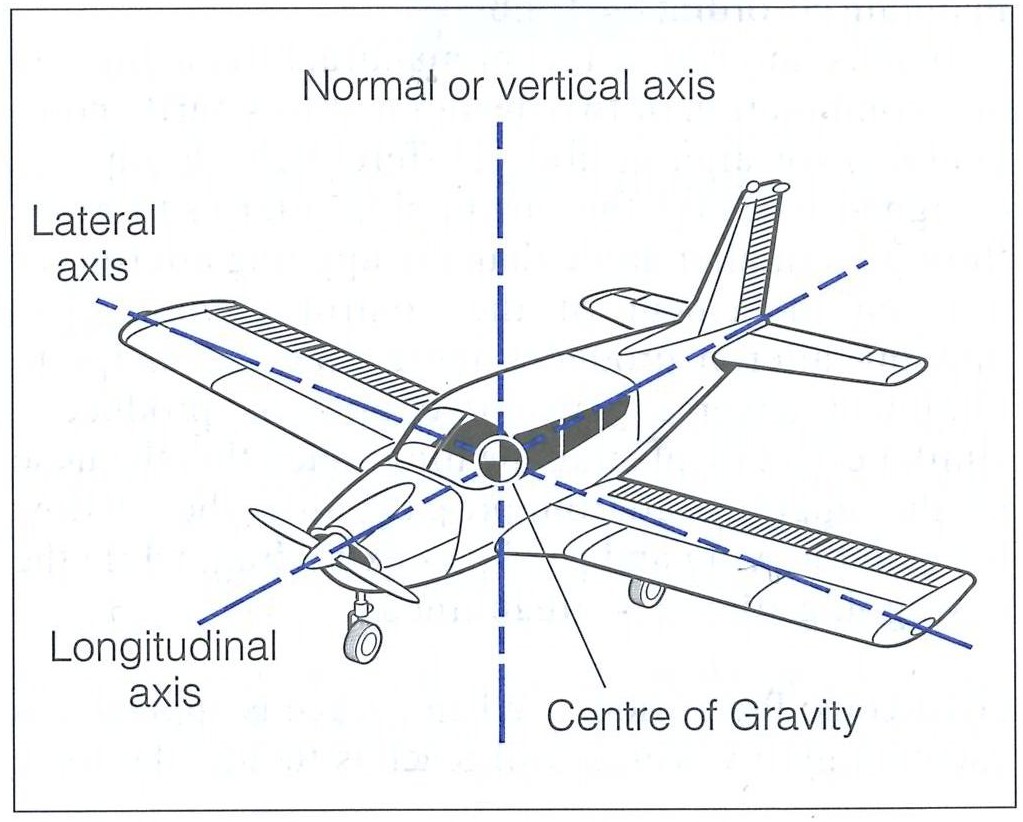
These axes all pass through a central point in the aircraft.
Through the lateral axis the aircraft will Pitch nose up or nose down.
Around the longitudinal axis the aircraft will Roll left or right
The final axis of control is the normal axis, sometimes called the vertical axis. Around this axis the aircraft will Yaw left or right.
Why must we have an understanding of flight controls?
Why must
we have an understanding of flight controls? –
To understand how to achieve coordinated safe and efficient
flight.
22.12.18
Show understanding of the theory of spoilers and give examples of their use.
Spoilers are attached to the upper and sometimes lower surface of the wing – at times both surfaces. Spoilers have a couple of uses; they can be used for roll control, either exclusively or in addition to ailerons. They are also used to control descent of the aircraft by adding drag.
On large transport aircraft they are also used to “kill” lift once the aircraft has landed.