Describe the effect of local obstructions on wind flow.
Small scale interference to wind flow
– eg shelterbelts, rows of buildings etc
A pressurised area forms on the windward side of the the obstruction which can extend horizontally up to 5 times the height of the obstruction.
As airflow bends over the obstruction a Venturi effect will accelerate the flow above and slightly to the lee of the obstruction; this is greatest up to 3 times the height of the obstruction.
The flow can be distributed downwind as far as 50 times the height of the obstruction.
Substantial turbulence can take place in the lee, horizontally up to 20 times the height of the obstruction.
Large scale interference to wind flow – see Mountain Waves
Describe the rotor zones process and explain the associated dangers to aircraft operations.
When rotor streaming winds approaching a mountain range decrease in height, from the mountain ridge and up, rotor zones are created.
This has the effect of putting a “lid” on the strong airflow crossing the range, so the wind velocity on the lee side is very strong and turbulent. Flight close to the lee of the range and below mountain height is fraught with danger under these conditions.
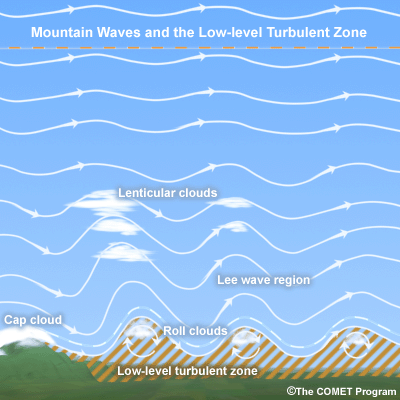
Explain the wind and weather conditions, and associated main dangers to aircraft operations,in mountain wave conditions.
Development of a mountain wave requires the following:
– A substantially large mountain range
– A low level wind of at least 15 knots with strength increasing and generally retaining its direction with height
– an unstable atmosphere at low levels a stable layer at or just above the mountain tops and a less stable or slightly unstable atmosphere above the inversion
Dangers to aircraft operations includes:
– Moderate to severe turbulence on the lee side
– Possible existence of rotor action on the downwind side below the height of the mountains
– Strong downdraughts on the lee side especially close in to the mountains
Describe the mountain wave (standing, or lee wave) process.
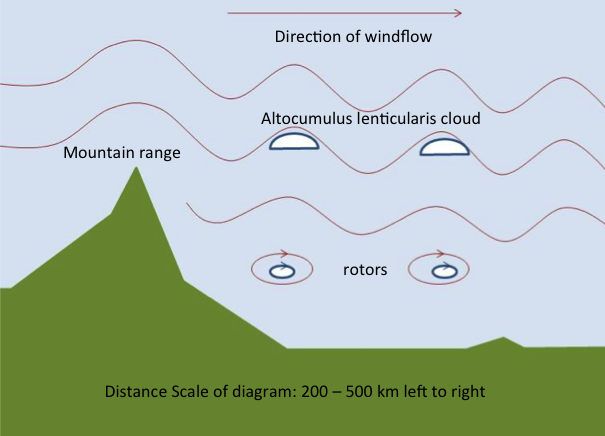
Mountain waves are accompanied very often by spectacular lens shaped high level cloud formations called “lenticular” clouds
Development of a mountain wave requires the following:
– A substantially large mountain range
– A low level wind of at least 15 knots with strength increasing and generally retaining its direction with height
– an unstable atmosphere at low levels; a stable layer at or just above the mountain tops and a less stable or slightly unstable atmosphere above the inversion
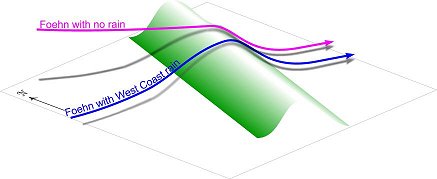
Describe the flight conditions associated with Fohn wind conditions.
Very warm conditions and turbulence can at times be moderate to severe at low levels, posing a risk to light aircraft operations especially during landing and takeoff phases.
Given environment temperatures, Dew points and mountain heights, determine the:
a)  cloud base on the windward side;
b)  cloud base on the lee side;
c)  temperature at stated datum level on the lee side.
a) The moisture content of the rising air is retained on the windward side in the form of rain and cloud drops, sticking to trees and rocks.
b) When air at the mountain top starts its descent on the lee side, it only needs to go down to 2000 ft in order to warm to the new Dew point. This means the cloud base on the lee side is high.
c) Air on the lee side of a mountain is much warmer that the windward side; due to loss of moisture it is so much drier.
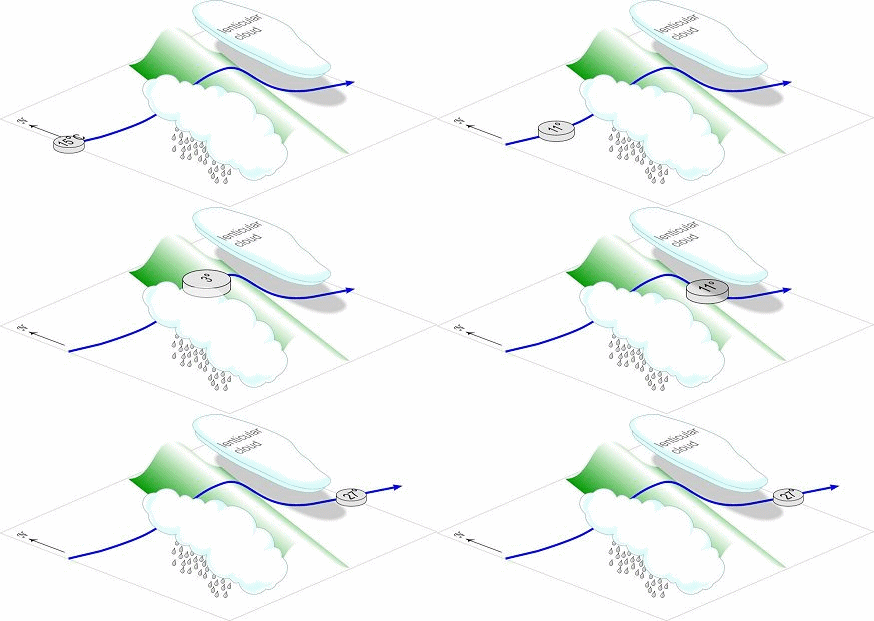
Describe the Fohn wind process.
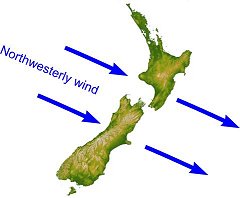
Fohn wind process is when warm dry air is blown off the Swiss Alps (eg also the Canterbury Norwester)
Development of a Fohn wind requires the following
– substantial mountain range
– a wind blowing at right angles to the mountains
– a high moisture content of the approaching air
Describe the katabatic and anabatic wind processes, and state the:
a)  typical timing of the occurrence;
b)  average strength of the winds;
c)  effect of moist valley air on cloud/fog formation;
d)  effect of gravity on Katabatic winds;
e)  effect of adiabatic cooling and warming.
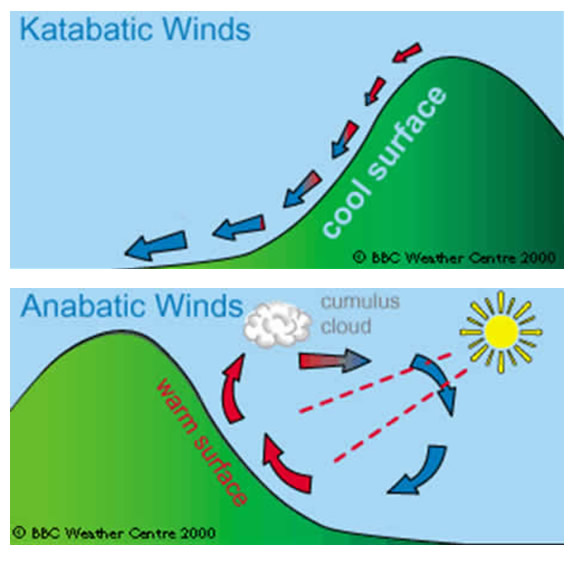
Katabatic wind is a wind which descends at certain times in mountainous terrain.
Anabatic winds go upwards; ie opposite to a katabatic wind
Katabatic winds are essentially a night time phenomenon, sometimes going into the morning
Anabatic winds are associated with warm air rising after sunrise, with warming through conduction
When the valley floor and parts of the sloping walls go into shadow towards the end of the day, air touching the cold walls cools through a process of conduction. This leads to an increase in density of the affected air, so it will sink and draw adjacent air down with it.
When the cold air settles at the valley floor it can enhance the development of fog.
Colder air is denser than warmer air and thus will tend to sink
Describe the effect of local obstructions on wind flows
A local low-level obstruction to a strong surface flow will create tumbling and turbulence downstream from the object
Immediately downwind the air will be dumping toward the ground creating a localised down- draught
The turbulent area created by an object in the air flow extends to twice the height of the object vertically and 15 times the height of the object horizontally before steady frictional flow is re-established
Describe the land breeze process, and state:
a)  typical timing of the occurrence;
b)  average speed of the wind;
c)  most likely season for the occurrence.
This wind is the reverse of the sea breeze – ie it blows from the land to the sea
a) When the land cools from evening onwards, the sea remains relatively warm, sea air tends to rise and replacement air flows from the land to sea.
b) Land breeze is rarely more than 3-4 knots
c) In the autumn the sea is still warm after a long summer, but the land starts to experience the occasional early frost, making this season the most likely for land breezes to occur.