State the altitudes relative to the freezing level where rime ice or clear ice can be expected in cloud.
Clear Ice
Altitude = 6-8,000 ft above the freezing level
Rime Ice
The first few thousand feet above the freezing level
State the altitudes relative to the freezing level where rime ice or clear ice can be expected in cloud.
Clear Ice
Altitude = 6-8,000 ft above the freezing level
Rime Ice
The first few thousand feet above the freezing level
State the types of cloud, and cloud drop size, that are conducive to the formation of each type of ice.
Clear Ice
– large cloud drop size , mostly found in Cumuliform cloud
Rime Ice
– small drop size associated with Stratiform clouds with little or no turbulence in them
With regard to airframe icing, explain the processes involved in the formation of:
a)  clear ice;
b)  rime ice;
c)  hoar frost;
d)  freezing rain.
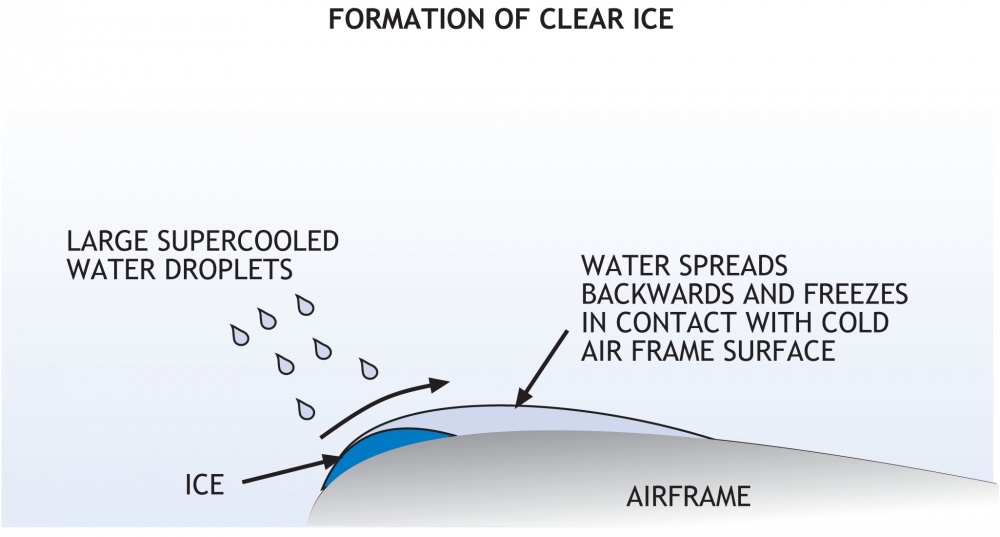
a) Clear Ice
Clear ice is formed when relatively supercooled water drops at temperatures between zero degrees and about minus 15 degrees are struck by an aircraft
On impact a small part of each drop will freeze instantly but the remainder remains as liquid and flows back over the wing and fuselage – freezing progressively and squeezing out any air bubbles that may have formed
A solid layer of glass-like ice forms being difficult to dislodge.
b) Rime Ice
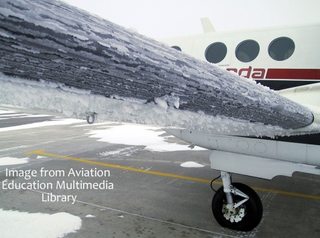
When the temperature of droplets is colder than minus 15 degrees the percentage of water flowing back and freezing progressively is much reduced because the greater portion of drops freezes instantly. When these drops are struck by a passing aircraft most of the supercooled water changes to ice and in doing so traps bubbles or air within the ice formation. This ice is a milk like character and of irregular shape
The irregular shape greatly upsets the aerodynamics of the wings and other components and lift is reduced and drag increased.
Higher stall speed and potential blocking of intakes
c) Hoar Ice
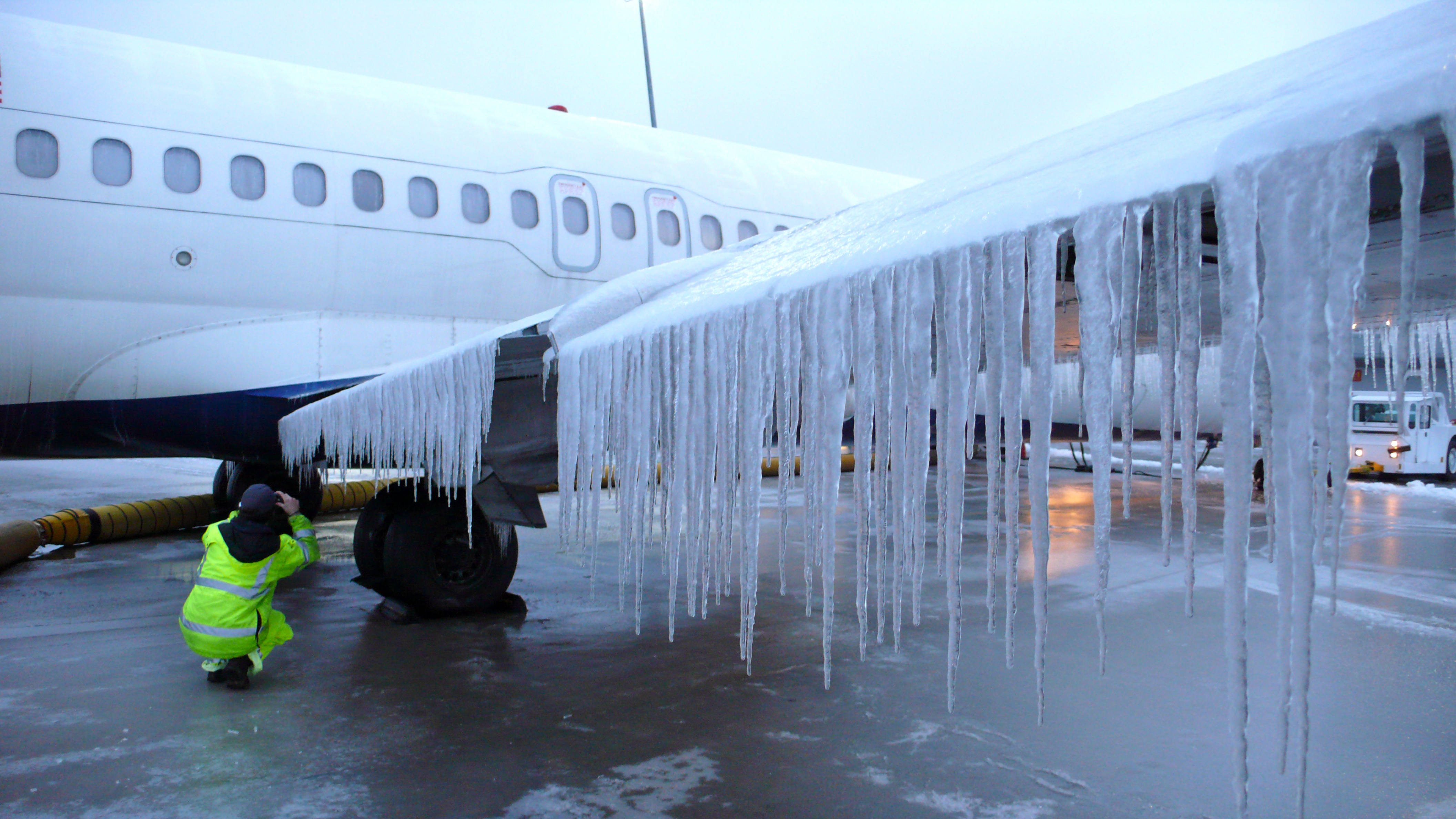
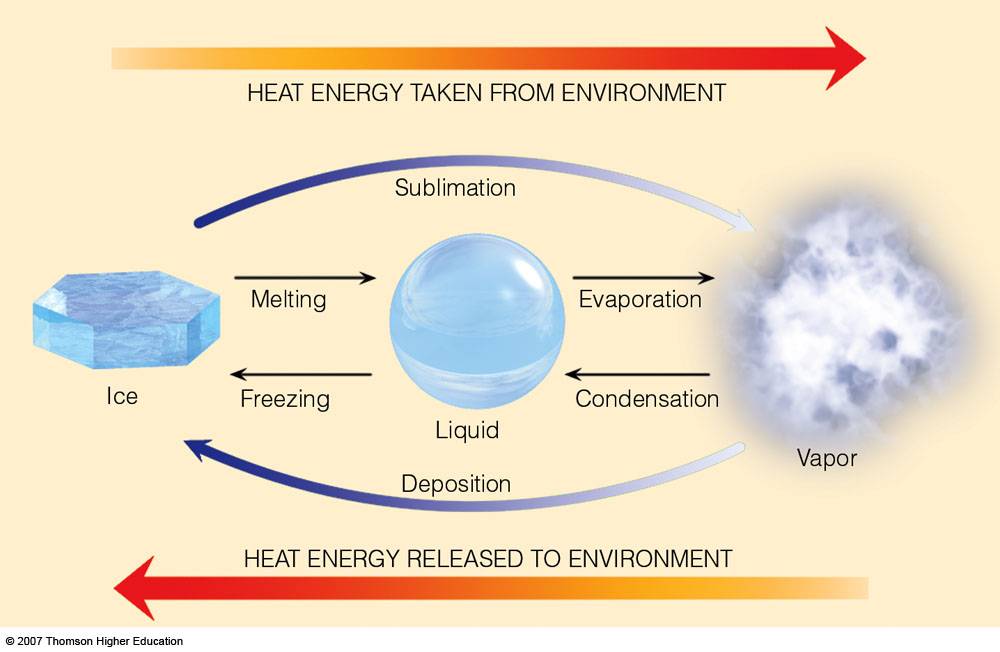
This type of ice is formed through the deposition process when water vapour turns directly to ice without going throught the liquid water stage. It may form when an aircraft parked overnight in frosty conditions water vapour touching on the aircraft skin will turn straight to ice
Can cause increased weight and drag, reduce lift and increase stall speed – Very dangerous
d) Freezing Rain
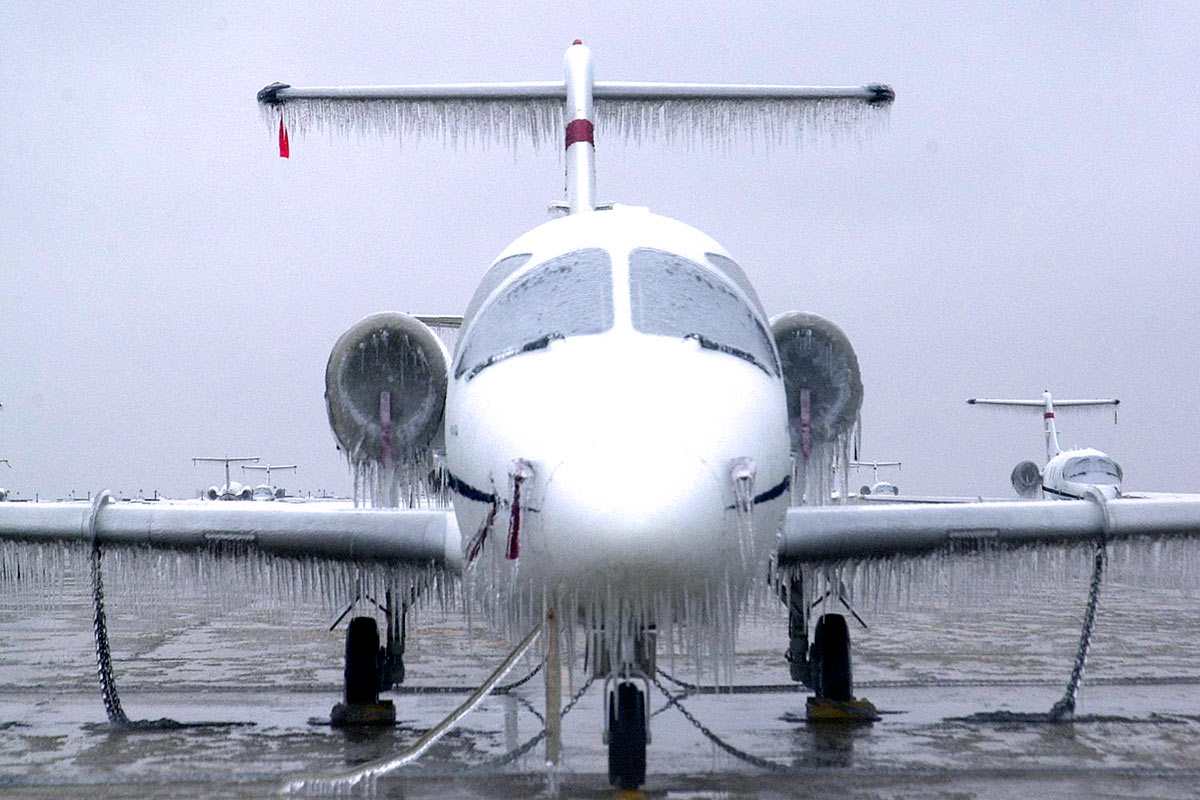
In frontal and inversion conditions, warm precipitation droplets can fall into a lower air layer which is colder than freezing – becoming super-cooled. An aircraft flying in such a layer can be covered ery quickly in layers of clear ice
Explain the processes of freezing and melting.
Freezing – liquid turns to solid – Latent heat released
Melting – solid turns to liquid – Latent heat required
8.28.12 State the hazards for light aircraft from the following
As a rule, solid precipitation is not a hazard to aircraft in terms of icing because it bounces of the airframe. However,
there are still hazards associated with snow, sleet and hail.
(a) Snow;
Snow encountered during flight will tend to swirl around the aircraft. It will accumulate against objects where it can
become trapped – under the windscreen wipers for example – however the biggest threat in flight is the very poor
visibility it creates.
Snow on the aircraft while parked on the ground is another matter altogether. It should be fully removed before flight
is attempted.
(b) Sleet;
Sleet will tend to stick to the aircraft in flight; however, the problem is not that serious because sleet, by its very
nature, is only found beneath the freezing level in air that is a degree or two warmer than zero Celsius. Consequently,
if possible, descent by perhaps 500ft, should get you below the sleet level.
If, however, you cannot descend, or you elect to continue flight in sleet conditions, the build-up of slushy ice on the
leading edge of the wing will cause the stall speed to slowly rise, and as you slow the aircraft on approach, a fully
developed stall is a distinct possibility.
(c) Hail.
Hail can cause serious damage to aircraft in flight or on the ground. In flight, medium sized hail (bigger than perhaps
10 – 15mm) will cause dents on leading edges. Hail stones bigger than about 20mm, will cause large dents on wings
and spinners, and may crack windscreens.
Aircraft parked outside in large hail will also be severely dented, and large hail will pass right through fabric-covered
aircraft like Tiger Moths, necessitating a complete re-skin of the aircraft.
8.28.10 Explain how to avoid or alleviate all forms of airframe icing other than hoar frost
The answer to this objective is simple – avoid flight in all cloud types above the freezing level. If you do decide to
undertake flight in cloud, and you observe ice forming anywhere on the airframe during flight, get out of the cloud
immediately, or descend below the freezing level immediately if possible.
8.28.8 Explain why flight in cloud above the freezing level can be very hazardous
Earlier in the Met course, we established that aerosols are an important ingredient in the development of cloud.
Inside every cloud droplet (and there are billions of them), there is an aerosol. Now, aerosols come in two forms:
Condensation nuclei and Freezing nuclei. Below the freezing level, in temperatures greater than 0 deg C, every cloud
droplet must contain a condensation nucleus.
If we were to lift these droplets above the freezing level (into an environment where temperatures may be
significantly colder than 0 deg C), we would expect the droplet to freeze. But this doesn’t happen automatically. In fact,
unless the droplet contains a suitable freezing nucleus, it will remain liquid. These liquid water droplets are called
‘Super-Cooled Water Droplets’ or ‘SCWD’.
As the SCWD’s continue to rise into progressively colder air, they will eventually reach a temperature at which the
internal aerosol ‘switches’ from being a condensation nucleus to a freezing nucleus and at that point, the droplet will
freeze. The temperature at which this happens depends on the crystalline nature of the aerosol. By the time the air
temperature has cooled to -40C, all the condensation nuclei will have switched to become freezing nuclei.
Your aircraft is an amazingly good freezing nucleus. When SCWD collide with your aircraft, they will freeze to the
airframe on contact. So, all cloud immediately above the freezing level has the potential to create an airframe icing
problem. This is especially true if forced lifting has occurred i.e. in TCu, Cb and the updrafting portion of some Ac
Lenticularis cloud.
Flight into cloud above the freezing level exposes your aircraft to any of the potential hazards listed in §8.28.2 above
8.28.6 State the dangers of hoar frost and the actions required to alleviate these dangers on the ground and in flight
A coating of hoar frost formed on a parked aircraft overnight presents a very real threat to flight. It not only adds
weight to the aircraft, but if not cleared properly, it can markedly reduce lift, resulting in the aircraft failing to get
airborne before the end of the runway, or struggling into the air then stalling shortly after take-of.
This type of ice must be removed from the airframe before take-of is attempted. There are a few methods to do this,
but each has its drawbacks. They are:
• Delay take-of until the ice has fully melted naturally. This will work but your departure may be delayed for
several hours.
• Use a stiff broom to brush the worst of the ice of. This works but may damage the aircraft paint scheme. At
times, a thick layer of dew may form on the aircraft before freezing takes place. This ice cannot be removed
by brushing the aircraft.
• Spray the aircraft with a de-icing fluid, usually propylene glycol fluid. It works well, but it is expensive, and
it’s unlikely you can access it easily anyway.
• Spraying the aircraft with water from a garden hose. And of course, this works, BUT…it won’t work if the
hose was left outside overnight as the water in the hose will be frozen. If you can spray water on the aircraft,
keep spraying the entire aircraft until the whole skin has warmed to the temperature of the tap water.
Having done this, you should then endeavour to get airborne as soon as possible or you may inadvertently
end up with a worse icing problem as water on the aircraft skin and trapped in control surfaces etc. may,
within 15 to 30 minutes, freeze in the sub-zero air.
2.28.4 Explain the processes involved in the formation of hoar frost on an aircraft on the ground and in flight
Hoar frost forms mostly on aircraft parked outside on a cold winter’s night, however it can also form in flight.
The night-time/early morning hoar frost is simply a function of the land and adjacent surfaces (such as parked
aircraft) radiating heat to space on a clear night. This causes the land and the surfaces to cool to sub-zero
temperatures. Any dew on the aircraft then freezes and the process of deposition then continues to build ice crystals
directly onto the skin of the aircraft as frost (not just on the wings, but all over).
NOTE: This type of icing is extremely dangerous if not properly removed before flight is attempted (see §8.28.6
below). The CAA’s accident files describe any number of aircraft accidents attributed to hoar frost which has not
been properly cleared from the aircraft.
Hoar frost in flight occurs when an aircraft is initially flown in temperatures colder than 0oC for a period, such that
the skin of the aircraft cools to temperatures colder than zero. If the aircraft then descends into cloud, or even into
air beneath the freezing level with a high relative humidity, hoar frost will form quickly on the aircraft skin. This form
of hoar frost is not normally dangerous as it melts very quickly. However, if the freezing level is very low and it forms
on the windscreen, it may reduce the pilot’s visibility to zero at a crucial stage during the approach.
8.28.2 List the hazards of airframe icing to aircraft in flight
Aircraft` may be exposed to many hazards if airframe icing is encountered in flight. While it is unlikely
that an aircraft` flying under VFR rules will encounter all or perhaps any of these hazards, the magnitude
of the list should be a very good indicator to PPL pilots of the danger icing poses to aircraft` in flight.
The hazards are: Decreased lift