4.82.14 Describe the procedures for directing a surface craft to a distress incident. AIP GEN
Transmitting precise instructions by any means available. If such precise instructions cannot be transmitted, they should be given by carrying out the following procedure:
- circle the surface craft at least once;
- cross the projected course of the surface craft close ahead at low altitude:
(i) rocking the aircraft; or
(ii) opening and closing the throttle; or
(iii) changing the propeller pitch.
- then head in the direction in which the surface craft is to be directed and
- repeat these procedures until the surface craft acknowledges.
Because of the high noise levels on board surface craft the sound of changes in throttle settings and propeller pitch may be less effective than rocking the aircraft, and are regarded as an alternative means of attracting attention.
4.82.12 Describe and interpret ground-air visual signal codes. AIP GEN
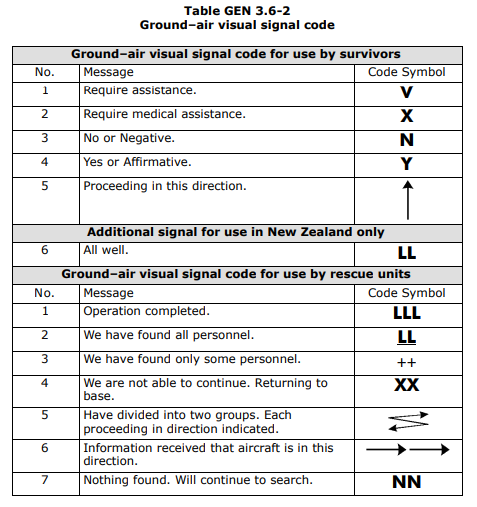
4.82.10 Describe the use of the speechless technique using unmodulated transmissions. AIP ENR
When an unmodulated transmission is heard, the ATS operator will request the pilot activate the transmitter three times; and
if the pilot complies ATS will frame questions requiring “YES” or “NO” answers to determine if the aircraft:
- can continue visually; or
- can execute an instrument approach, or has reached a nominated position.
“YES” / “ROGER” – activate transmitter once
“NO” – activate transmitter twice
“SAY AGAIN” – activate transmitter 3 times
“AT NOMINATED POSITION” – activate transmitter 4 times
4.82.8 Describe the means by which ATC will verify the transmission of an emergency SSR transponder code. AIP ENR
Whenever it has been established that an aircraft is transponding on code 7500 the controller will attempt to verify by RTF with the aircraft concerned that the code selection is intentional
“ … (CALL SIGN) … CONFIRM SQUAWKING SEVEN FIVE ZERO ZERO”
If the reply is in the affirmative or if no reply received, this will indicate the aircraft is subjected to unlawful interference.
4.82.6 State the transponder code a pilot should set to indicate that the aircraft is being subjected to unlawful interference. AIP ENR
7500
4.82.4 State the transponder code a pilot should set to indicate a loss of communications. AIP ENR
7600
4.82.2 State the transponder code a pilot should set to indicate an emergency condition. AIP ENR
7700
4.80.8 State the pilot action required following deviation from the CA Act or rules in an emergency situation. CA Act 1990 S13A
- Immediately notify the relevant air traffic control service of the action; and
- As soon as practicable, notify the Director of the action and the circumstances that necessitated it, and, if requested by the Director, provide to the Director a written report in respect of the action.
4.80.6 State the extent to which a pilot may deviate from the CA Act or rules in an emergency situation. CA Act 1990 S13A
A breach of any prescribed requirement is permitted only if:
- the emergency involves a danger to life or property; and
- the extent of the breach of the prescribed requirement goes only as far as is necessary to deal with the emergency; and
- there is no other reasonable means of alleviating, avoiding, or assisting with the emergency; and
- the degree of danger involved in complying with the prescribed requirement is clearly greater than the degree of danger involved in deviating from it.
4.80.2 State the requirement for the notification of accidents. CAR 12 [vfr_Rule p1=”12.51″]
The pilot-in-command, or if unable the operator, shall notify the Authority as soon as practicable.
Details of an accident must also be provided within 10 days of the accident